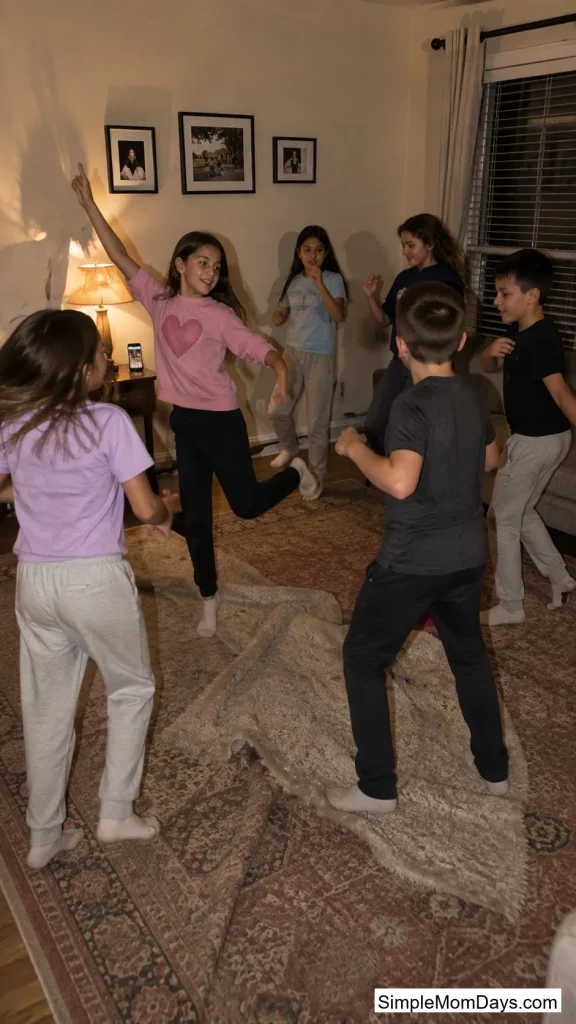
Ten kids show up, the cake still needs forty minutes in the oven, and somebody has already asked “what are we doing now?” three times. This is the moment every parent hosting a group of kids eventually hits — birthday party, rainy afternoon, classroom indoor recess, cousins’ reunion, doesn’t matter. What you need isn’t a Pinterest board of craft projects. You need a game that works with the kids already in the room, using stuff you already own.
Every game on this list works with a group, needs little to no shopping, and can be explained in under a minute. Some ask for zero supplies at all — just bodies and space. Others use a balloon, a blindfold, or a tray of random objects from a junk drawer. None of them need a trip to the store the morning of.
They’re grouped by what they’re actually good for: burning energy, calming a group back down, getting quiet kids talking, or working together on something. Pick based on what your group needs right now, not what looks cutest in a photo.
Games That Need Absolutely Nothing
No equipment, no prep, no setup time. Just kids, space, and someone willing to explain the rules once.
1. Everybody’s It
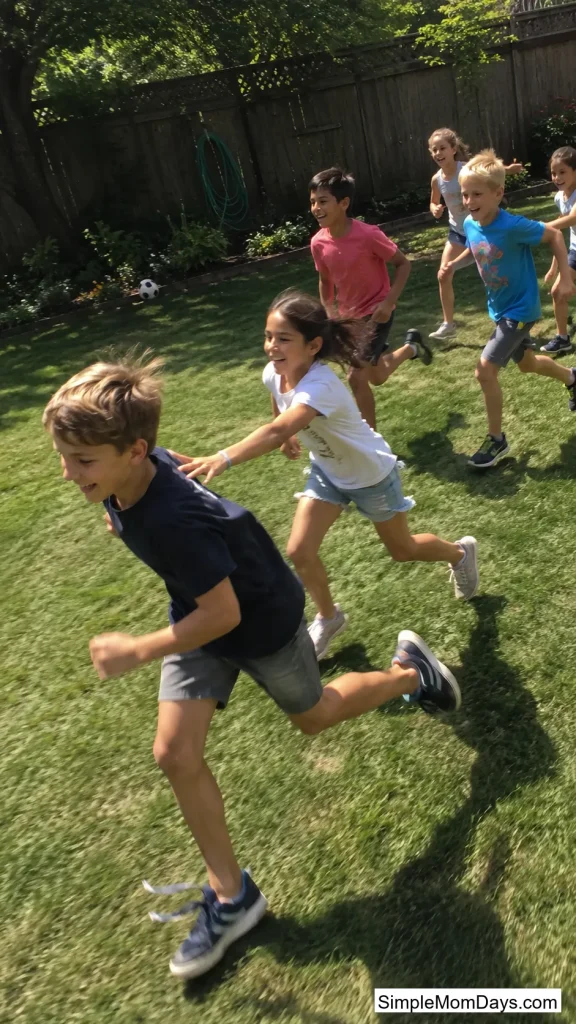
Regular tag has one problem for a big group: most kids spend the whole game standing around waiting for their turn to run. Flip that by making every single player “it” at once. Everyone chases everyone. Get tagged, you’re out and you sit down where you got caught. Last one standing wins.
The game moves fast because there’s no downtime — kids are either running or dodging from the first second. It also solves the classic complaint of “he’s not even trying to tag anyone,” since there’s no single chaser to slack off.
Works best with at least six kids in an open space like a yard or a gym. Rounds usually wrap up in two to four minutes, so plan on playing it several times back to back.
2. Sardines
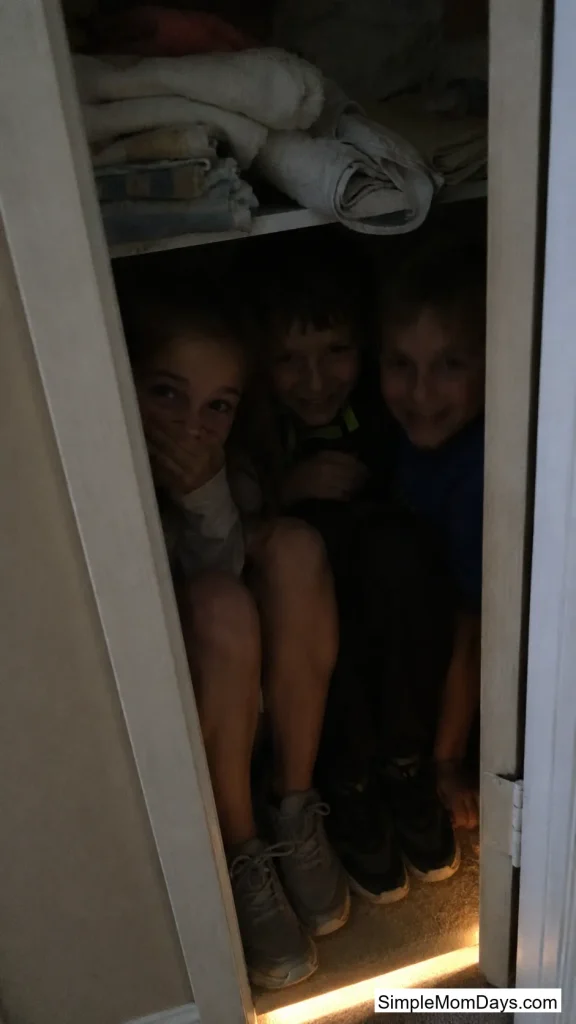
This one runs hide-and-seek in reverse. One kid hides while everyone else closes their eyes and counts to fifty. Then the group splits up to search — but whoever finds the hider doesn’t shout it out. They squeeze into the hiding spot quietly and wait for someone else to stumble onto them too.
The fun builds as the hiding spot gets more crowded and kids start stifling giggles trying not to give away the location. The last person still searching alone becomes the next one to hide.
It needs a house or yard with a few decent hiding spots, and it works surprisingly well indoors on a rainy day when regular hide-and-seek feels too cramped.
3. Shadow Tag
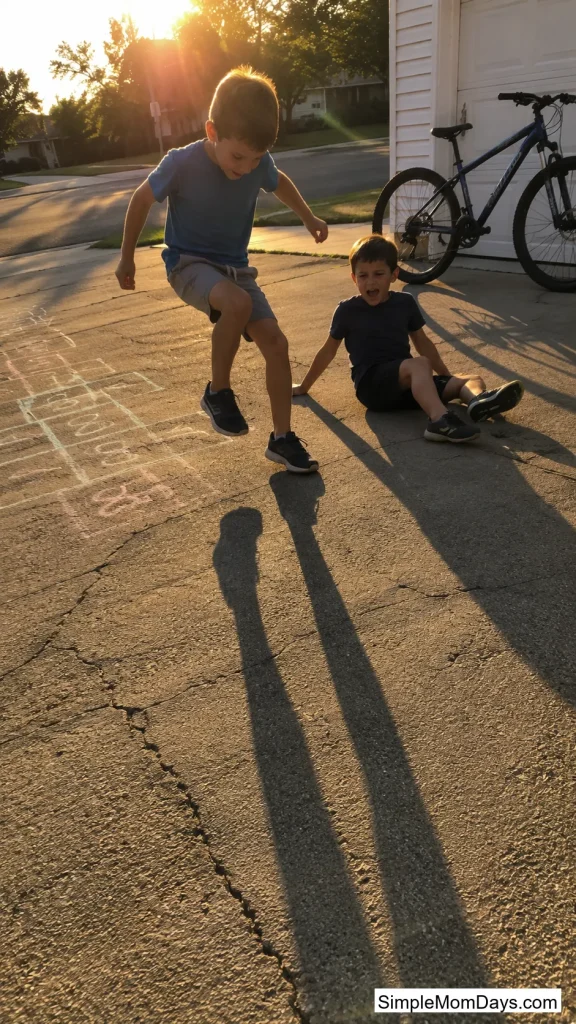
Same idea as tag, except the person who’s “it” tags shadows instead of bodies. Step on someone’s shadow, they’re caught. It sounds almost too simple, but kids get genuinely strategic about staying in shaded patches or keeping their shadow tucked behind them.
It’s gentler than regular tag since there’s no actual physical contact, which makes it a good pick for mixed-age groups where a five-year-old is playing next to a ten-year-old. Sunny late afternoons work best, when shadows stretch long and are easy to spot and easy to dodge.
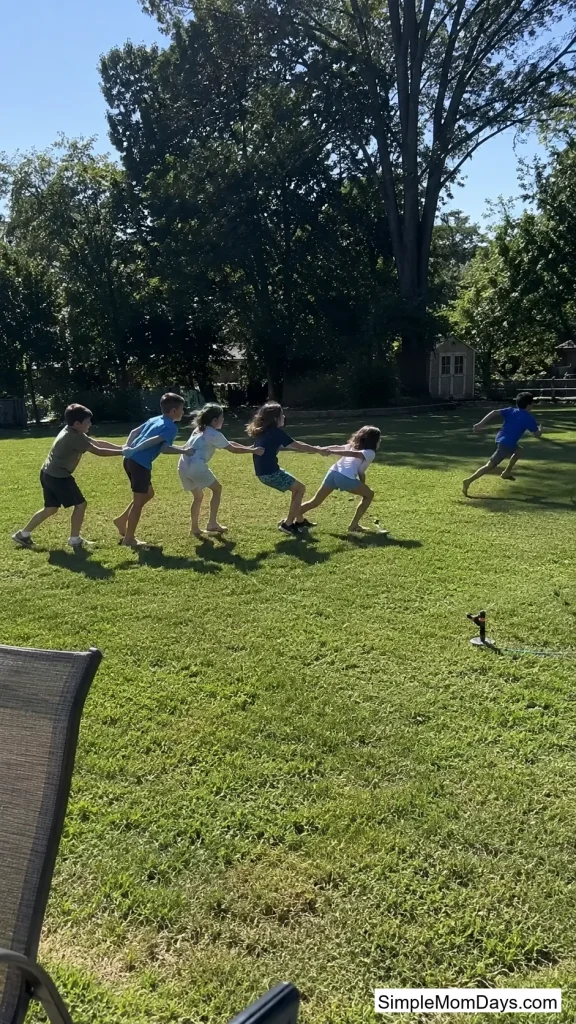
4. Blob Tag
One kid starts as “it.” Whoever they tag joins hands with them, and the two-person blob keeps hunting together, always connected at the hands. Every new catch joins the chain until one giant, wobbling line of kids is chasing the last few free players.
The blob has to move as a unit, which turns tagging into a coordination problem — the whole chain has to swing together to corner someone. That built-in clumsiness slows down bigger, faster kids and gives smaller ones a real shot at staying free longer.
Best for groups of eight or more in a wide open space, since the blob takes up a lot of room once it grows past four or five kids.
Circle Games That Get Everyone Talking
Get the group sitting or standing in a circle and these take over from there — good for a lull between activities or as a quieter opener before louder games.
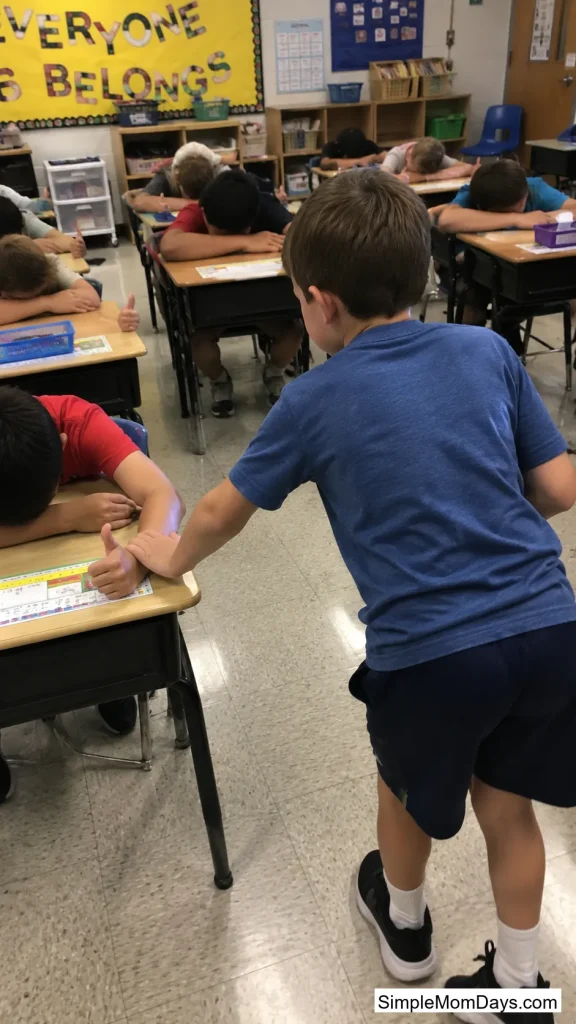
5. Heads Up, Seven Up
Everyone puts their head down on a table or their knees, thumbs sticking up. Seven kids quietly walk around and each gently press down one thumb, then return to the front of the room. Heads come up, and the seven kids who got picked have to guess which of the seven “tappers” chose them.
Guess right, and you swap places with that tapper for the next round. Guess wrong, and you’re back to guessing next time. The quiet buildup followed by the guessing makes it a nice change of pace from anything loud or physical.
Needs at least fourteen or fifteen kids to work properly, since seven need to guess and seven need to tap. Great for a classroom or a big family gathering, less so for a party of six.
6. Whisper Down the Lane
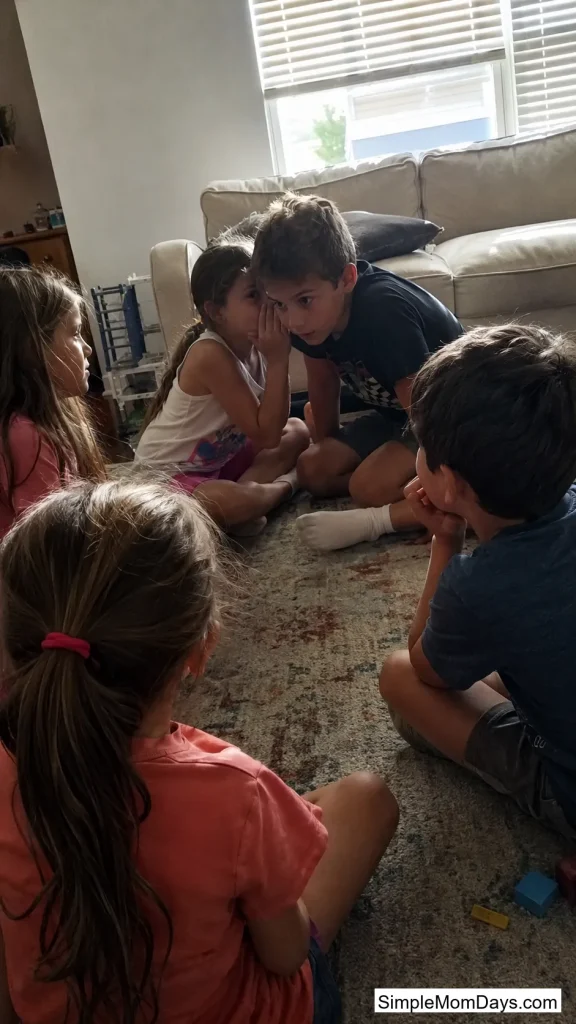
Sit everyone in a circle or a line. The first kid thinks of a short, slightly odd sentence and whispers it once into the next kid’s ear. That kid whispers what they heard — not what they think was meant — to the next person, and so on down the line.
The fun is entirely in the wreckage. By the time the message reaches the last kid, “the purple dog ate my homework” might have turned into “a turtle drove my grandma to school.” Saying the original sentence out loud at the end, next to whatever it became, usually gets the biggest laugh of the game.
Works for almost any group size, though it’s funniest with ten or more kids so the message has room to warp.
7. Two Truths and a Fib
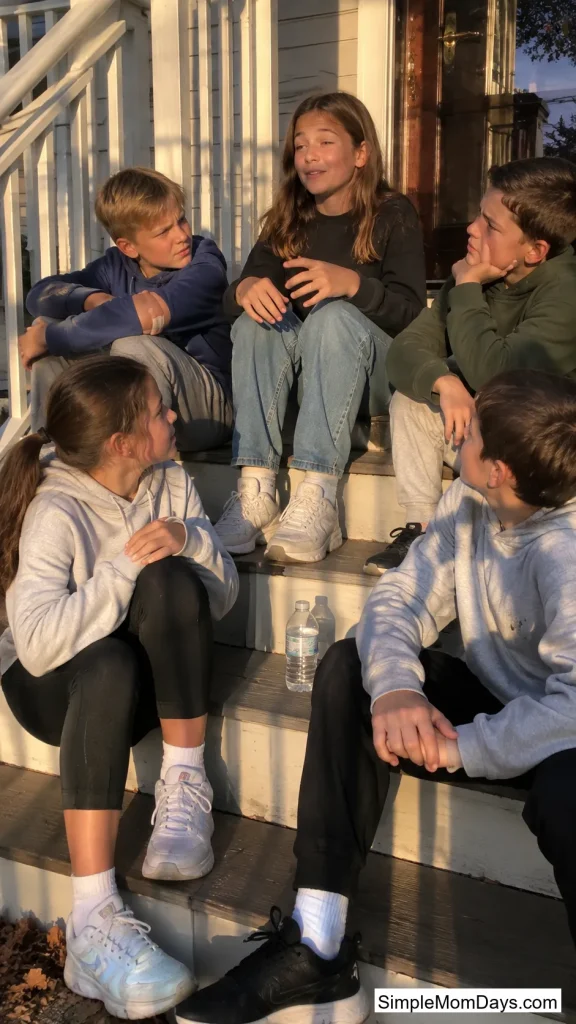
Each kid says three things about themselves — two true, one made up — and the rest of the group votes on which one they think is the lie. Works well as an icebreaker for kids who don’t all know each other yet, like a new classroom or a mixed group of cousins meeting for the first time.
The best rounds come from kids who make the lie boring and one of the truths sound completely made up — “I’ve never broken a bone” said by a kid who clearly has a cast story to tell fools almost everyone.
Better suited to kids around eight and up, since younger ones tend to struggle with keeping a straight face or understanding what counts as believable.
8. Stone Face Showdown
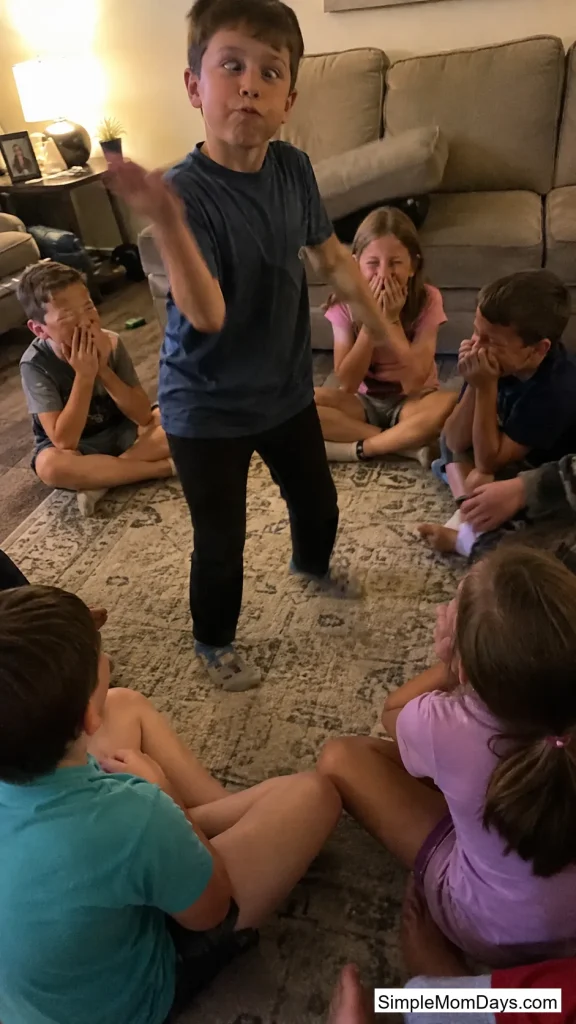
One kid stands in the middle of the circle and has thirty seconds to make everyone else laugh using only funny faces, sounds, and movement — no touching, no talking in real words. Anyone who cracks a smile or laughs joins the middle as backup entertainers for the next round.
It flips the usual game logic: instead of getting eliminated for laughing, you get pulled into the fun part. That keeps kids who lose their composure early from feeling left out, since they’re still in the game, just on the performing side now.
Rounds run fast, so it’s a good filler between bigger activities, and it needs zero setup beyond a circle of kids willing to be a little silly.
Games for When the Energy Needs to Come Down
For the stretch right after cake, or the last twenty minutes before pickup, when running around stops being the goal and staying in one piece does.
9. Four Corners
Label the four corners of the room 1 through 4. One kid stands in the middle with their eyes closed and counts to ten out loud while everyone else quietly picks a corner to stand in. At “ten,” the kid in the middle calls out a number without opening their eyes, and everyone standing in that corner sits down and is out.
Keep going, calling a new number each round, until one kid is left standing. The quiet part — sneaking to a corner without giving it away — is half the fun, and the calling-out part gives kids in the middle a small feeling of power over a game they can’t even see.
Ideal for a classroom or any room with four clear corners, and it works for almost any group size above six.
10. Museum Statues
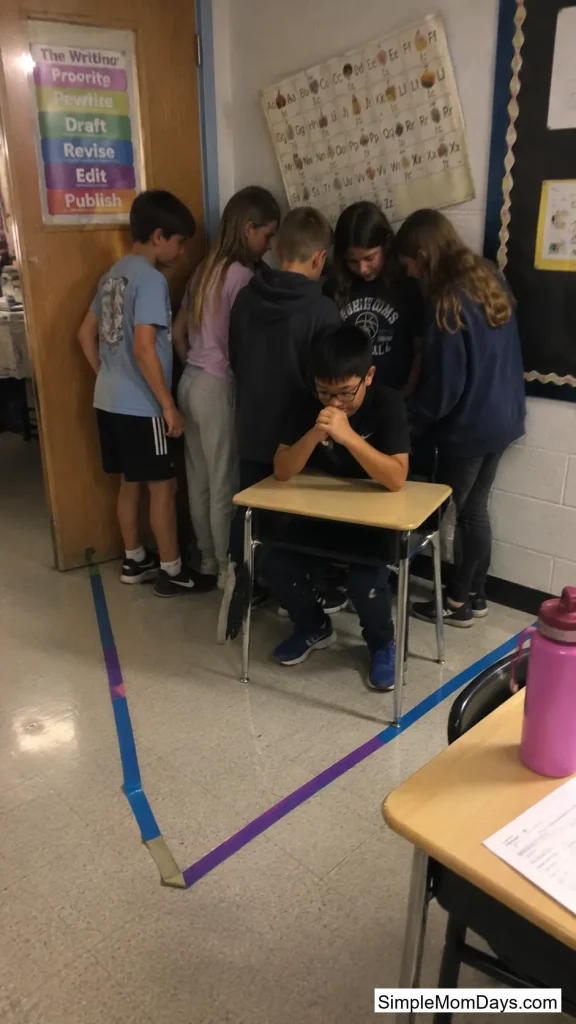
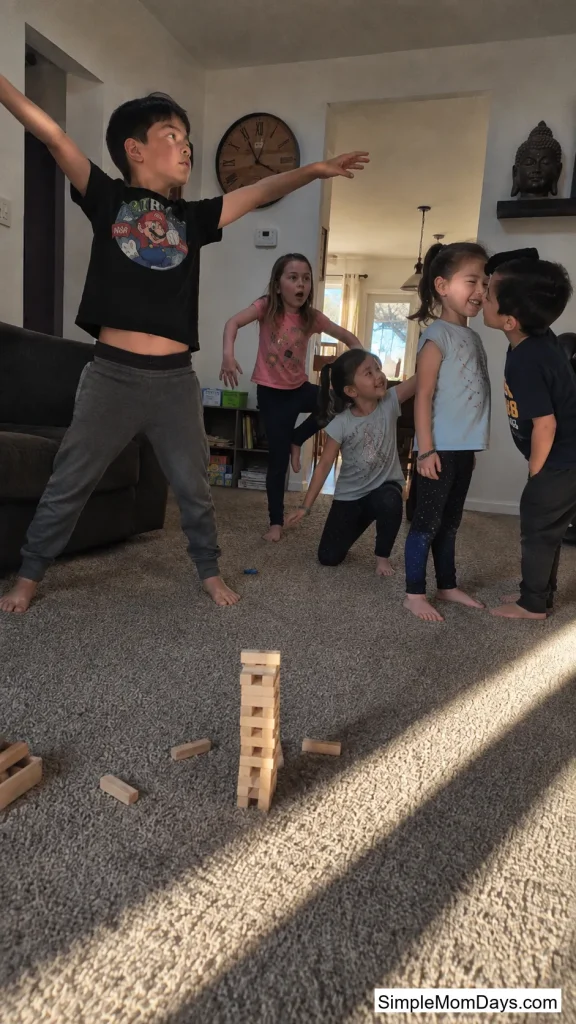
One kid is the museum guard and steps out of the room for twenty seconds. Everyone else freezes into a pose, like statues on display. The guard walks back in and wanders the room, examining each “statue,” and can try to make them move or laugh — no touching, just funny comments or faces up close.
Any statue that moves or breaks their pose gets called out and sits down. The last kid still frozen becomes the next guard. It’s a nice combination of stillness and suppressed giggling, which naturally brings the noise level down without anyone actually being told to be quiet.
Great after a loud game, since it forces a physical reset — kids have to stand still and hold a pose, which slows breathing and heart rate almost by accident.
11. Kim’s Game
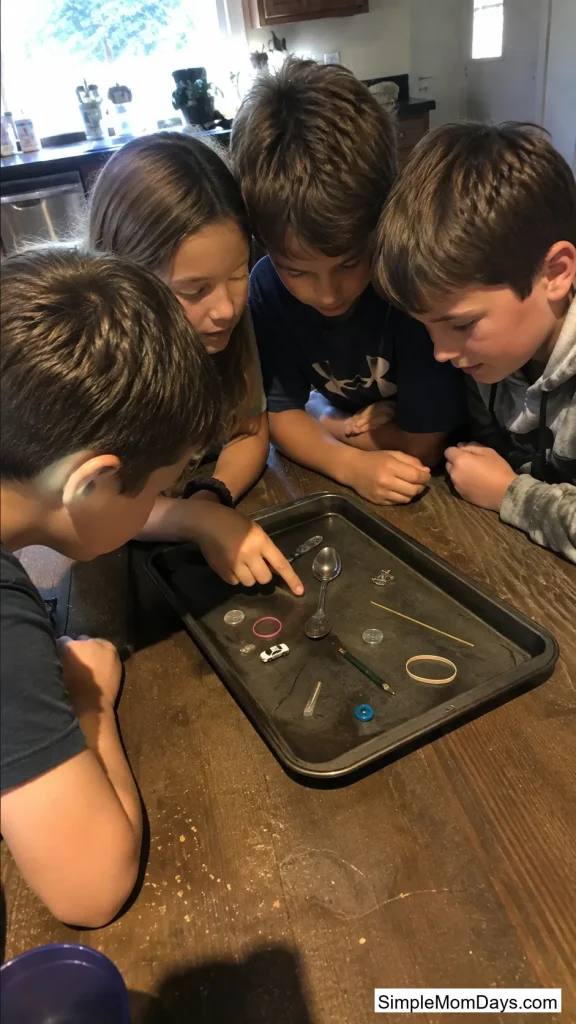
Put fifteen to twenty small household objects on a tray — a spoon, a hair tie, a coin, a toy car, whatever’s around. Let the group study the tray for one minute, then cover it or take it away. Kids get two minutes to write or say as many objects as they remember.
Whoever remembers the most wins, though for younger kids it works just as well as a group effort where everyone calls out items together and you count how many the whole room can recall as a team.
This one takes real focus, so it’s a strong pick for calming a group down after something more physical, and it costs nothing since the tray comes straight from around the house.
12. Twenty Questions
One kid thinks of a person, animal, or object and keeps it secret. Everyone else takes turns asking yes-or-no questions, trying to narrow it down before they run out of their twenty guesses. “Is it alive?” and “Is it bigger than a chair?” tend to come out first, then things get more specific from there.
It rewards kids who think in categories rather than random guesses, and it’s genuinely fun to watch a group slowly close in on an answer through logic instead of luck.
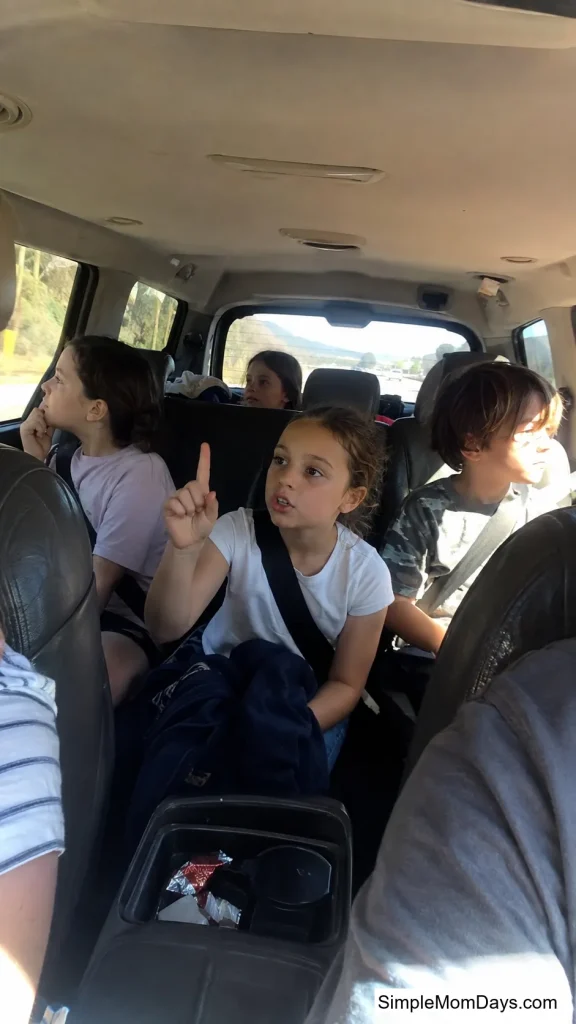
Works well for a small cluster of kids sitting together — a car ride, a waiting room, or a quiet corner at a party — and holds up for ages six and up.
Team Games That Build Something Together
These need two or more small teams and a little cooperation, which makes them a good pick when you want kids working with each other instead of just against each other.
13. The Human Knot
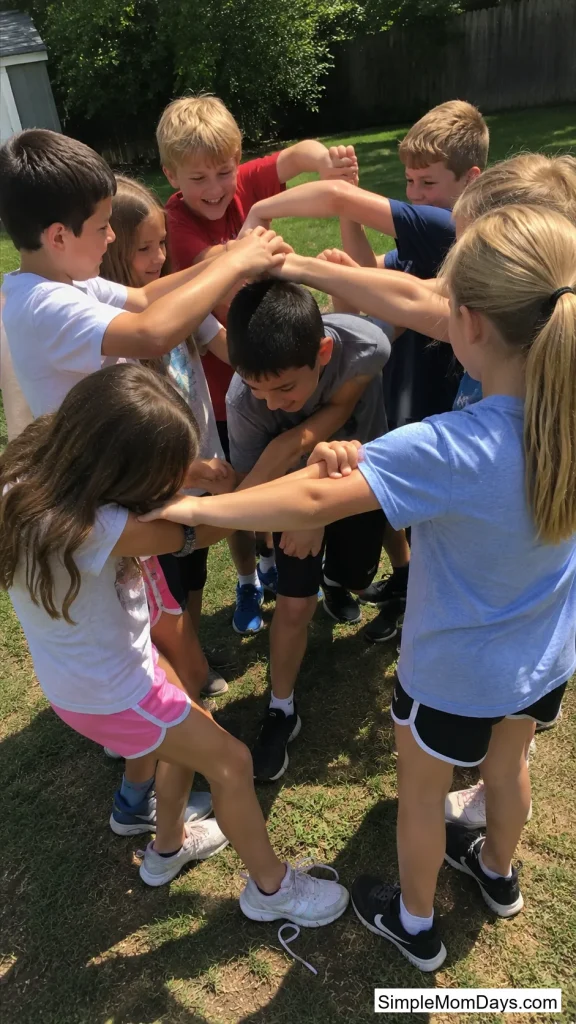
Get six to ten kids standing in a circle, shoulder to shoulder. Each kid reaches across and grabs two different hands from other kids in the circle — not the person directly next to them. Once every hand is holding another hand, the group has to untangle itself into a single circle without ever letting go.
It takes a surprising amount of communication — kids have to call out directions, duck under arms, and figure out who needs to step over whom. Some knots come apart in under a minute; others turn into a genuinely tricky puzzle that takes real teamwork to solve.
Best for kids around seven and up, since younger kids sometimes struggle with the spatial reasoning part, though they usually have fun just being tangled up regardless.
14. Blindfolded Team Drawing
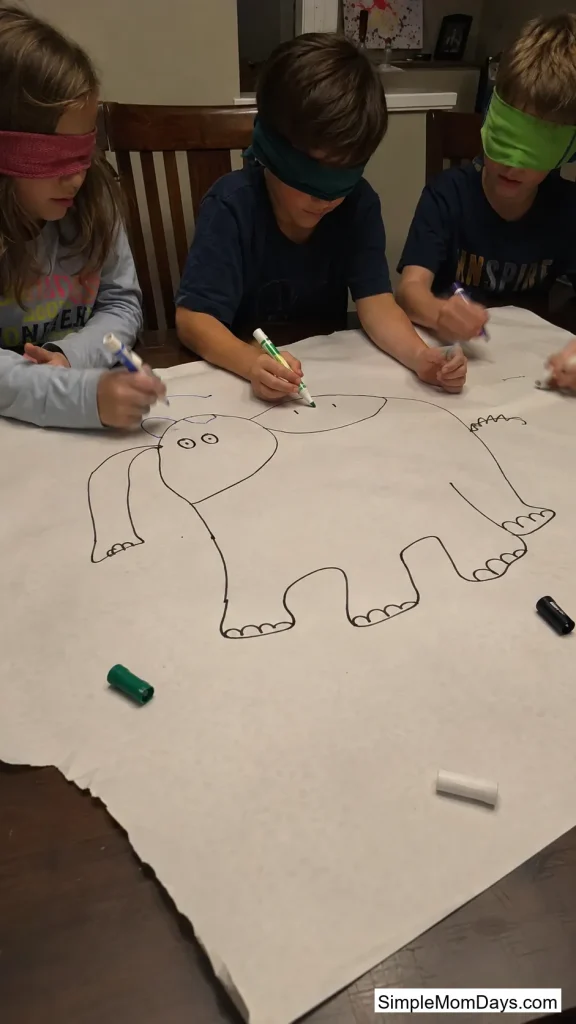
Split into teams of three or four and give each team one big sheet of paper and a marker. Blindfold the whole team. Announce something simple to draw — a house, an elephant, a birthday cake — and have team members take turns adding one part each, still blindfolded, while everyone else calls out directions.
The drawings come out hilariously wrong almost every time, with eyes floating off to the side or a leg attached to the roof. Judge the results together at the end for “most accurate” and “most creative disaster,” so every team walks away with a category they won.
Needs paper, markers, and a few blindfolds or scarves, and it works well as a slower, sit-down activity between rounds of something more active.
15. Categories Countdown
Pick a category — animals, foods, things you’d find in a kitchen — and go around the circle with each kid naming one item that fits. Anyone who repeats an already-said item, or freezes for too long, is out. Keep switching categories each round to keep it fresh.
It moves quickly and rewards quick thinking under a little bit of pressure, which makes it a favorite with kids who like a mental challenge more than a physical one. Adjust the categories to match the group’s age — “Disney characters” for younger kids, “capital cities” for older ones.
Works for any size group sitting in a circle and needs absolutely nothing beyond the words coming out of everyone’s mouth.

16. I’m Going on a Trip
The first kid says, “I’m going on a trip and I’m bringing a [something].” The next kid repeats that item and adds their own: “I’m going on a trip and I’m bringing a [first item] and a [second item].” Each player has to remember and repeat the entire growing list before adding something new.
It’s a memory game dressed up as a story, and the list usually gets absurd fast — nobody actually plans to bring a kangaroo and a toaster on a trip, but that’s exactly what makes it funny by round six or seven.
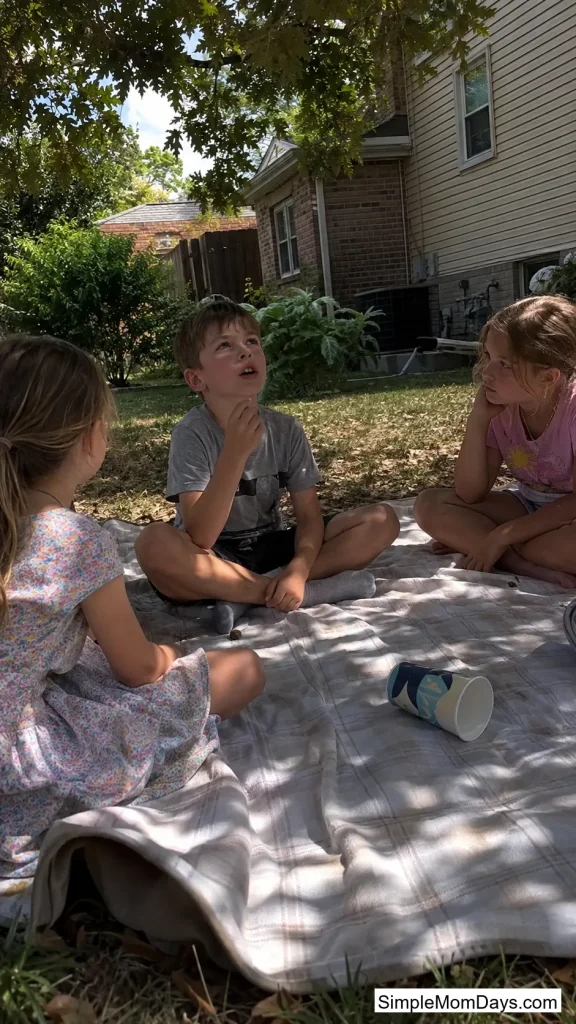
Best with kids old enough to hold a growing list in their head, so roughly six and up, and it plays well in a car, a waiting room, or seated in a circle at a party.
Backyard Games for Burning Off Energy
For the stretch of the afternoon when the group needs to move, and a yard or open room gives you the space to let them.
17. Balloon Keep-It-Up
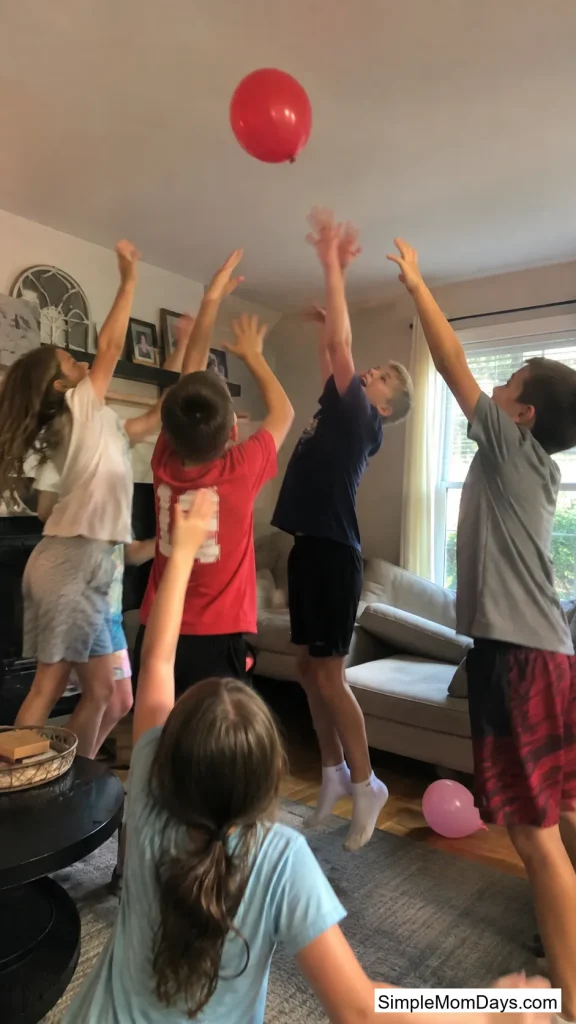
Blow up a few balloons and challenge the group to keep them from touching the ground, using anything except grabbing and holding on. For a bigger group, toss in a second or third balloon once the first one is airborne and watch the chaos multiply.
There’s no real winner in the traditional sense, which takes the pressure off younger kids who might not care about competing but still want to be part of the action. Add a rule where everyone has to touch a balloon before it can be hit twice by the same person to keep the game truly collective.
Works indoors in a decent-sized room or outdoors on a calm day — too much wind sends balloons flying off in directions nobody can control.
18. Cotton Ball Blow Relay
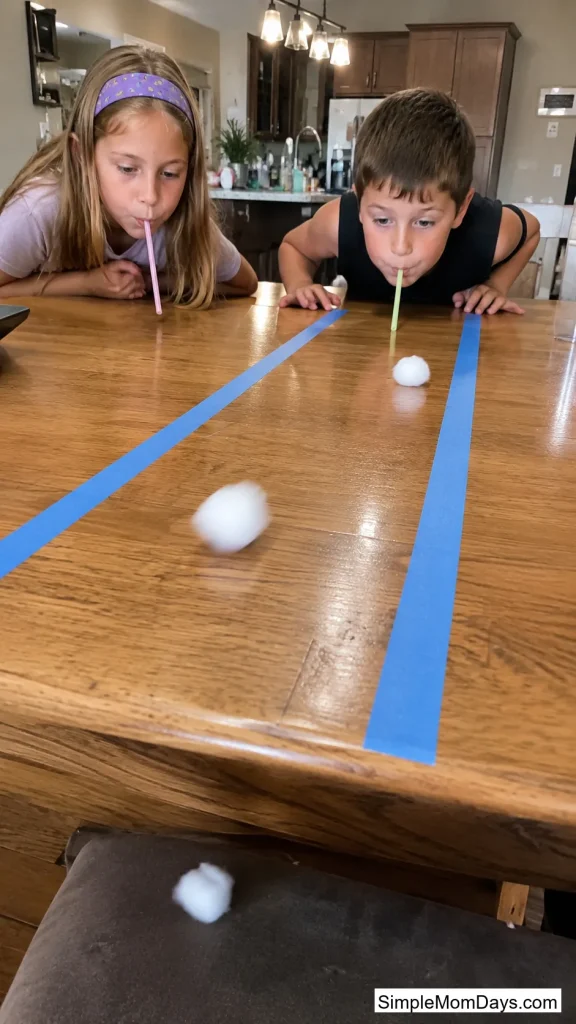
Tape a starting line and a finish line on a table or the floor with painter’s tape. Give each kid a cotton ball and a straw. On “go,” they have to blow through the straw to push their cotton ball across the finish line without using hands or breath tricks like puffing air from the side.
It looks easy until kids realize how little control they actually have over a cotton ball with just air. Watching a determined seven-year-old chase a drifting cotton ball across a table with a straw clenched in their teeth gets laughs from the sidelines every time.
Cheap to set up — straws, cotton balls, and tape are the whole supply list — and it works as a quieter, seated alternative when you want energy without noise.
19. Freeze Dance, No One’s Out
Play music and let the group dance however they want. When the music stops, everyone freezes in place, holding whatever silly position they landed in. Instead of eliminating whoever wobbles or moves, call out a fun challenge for everyone still moving — hop on one foot, freeze with your arms up, or hold your pose while making the silliest face possible.
Dropping the elimination part means the game never runs out of players, which matters for younger kids who tend to lose interest fast once they’re sitting on the sidelines watching everyone else play.
Any open space works, and a phone with a music app is the only real requirement — no need for a speaker unless the group is fairly large.
Not every game on this list needs the same group size or energy level, and that’s kind of the point. A party of six cousins in a living room needs something different than a classroom of twenty-five on a rainy Tuesday, and having a handful of options for both means you’re never standing there scrambling for an idea while ten kids wait for you to figure it out.
Print a few of these out, stash the list in your phone, or just keep the names in your back pocket for the next time someone says “I’m bored” a little too loudly.