Walk down any school hallway in October and you’ll see the same five bulletin boards on repeat: a spider web with photos tangled in it, a pumpkin patch with everyone’s name on a gourd, a Frankenstein pun about loving math. None of that is bad — it’s just been done enough times that nobody stops to look anymore.
These 23 ideas skip the recycled templates. Some sneak real science or geography into the spooky season, some turn the board into something kids actually interact with instead of glance at, and a few are built for spaces besides the classroom — the library, the faculty lounge, the front office.
Pick the ones that fit your grade level, your subject, and how much time you actually have this week. Most can be built with supplies already sitting in a classroom cabinet.
Interactive Boards That Do Something
These ask for more than a glance — a kid has to lift a flap, vote on an outcome, or crack a code before the board finishes doing its job.
1. The Mystery Door
Cover the board in black paper and cut a small round hole at kid-eye level, then frame it with a wooden embroidery hoop or painted cardboard so it looks like an actual door with a keyhole. Behind the hole, tape up a different mini-monster illustration each week — something only visible when a student presses their eye right up to the opening.
The appeal is the peeking itself. A flat board announces everything at once; this one makes a kid choose to look, which turns a hallway decoration into a small event kids talk about at lunch.
Swap the monster behind the door every Monday so there’s a reason to check back. An embroidery hoop works as the “keyhole” frame if cutting cardboard isn’t an option.

2. The Blackout Corner
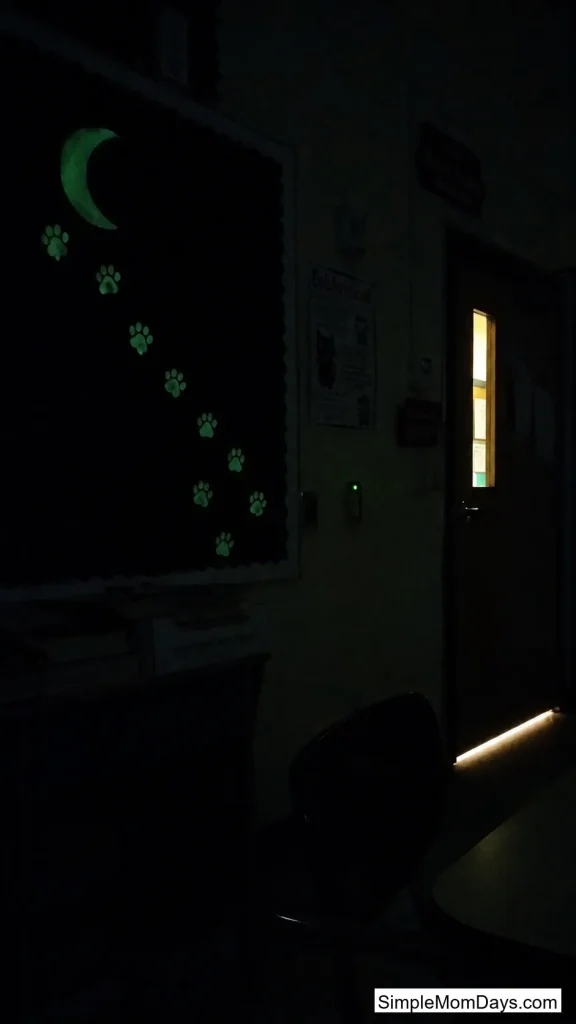
Paint part of the board with glow-in-the-dark paint pens — a moon, a cat’s eyes, a trail of footprints — layered on top of the regular Halloween scene. During the day it looks like any other board; flip the lights off for even thirty seconds and a second, hidden picture appears.
Most Halloween boards are static the moment they go up. This one has two versions depending on the time of day, which gives kids a reason to ask for the lights to go off — something they’d normally get told not to do.
Glow paint pens run under $10 for a multi-pack and work directly on black paper with no base coat needed. A UV flashlight makes the effect visible even without a full blackout.
3. Choose the Ending
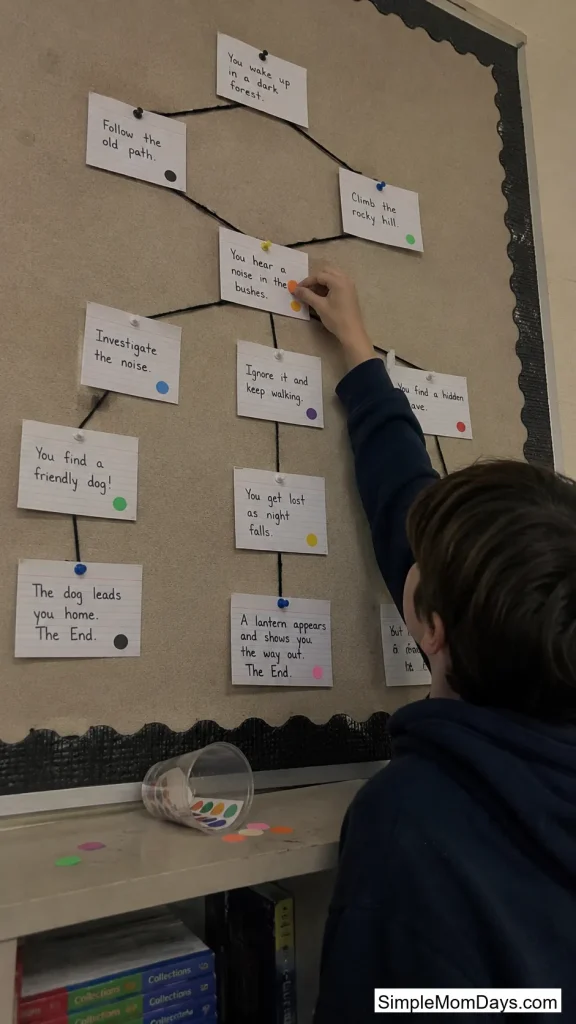
Write three or four short story branches on index cards — “the ghost knocks on the door” leads to two different cards depending on what students vote for — and pin them in a branching path connected with yarn. Add a small cup of colored dot stickers so students can vote on which path the story takes next.
It turns a bulletin board into a running class project instead of a finished product. Kids revisit it because the story is genuinely unresolved, not because there’s new decor.
Works especially well in an upper-elementary or middle school room, where students can read and vote independently between classes. Update the winning branch weekly based on the vote count.
4. Escape the Cauldron
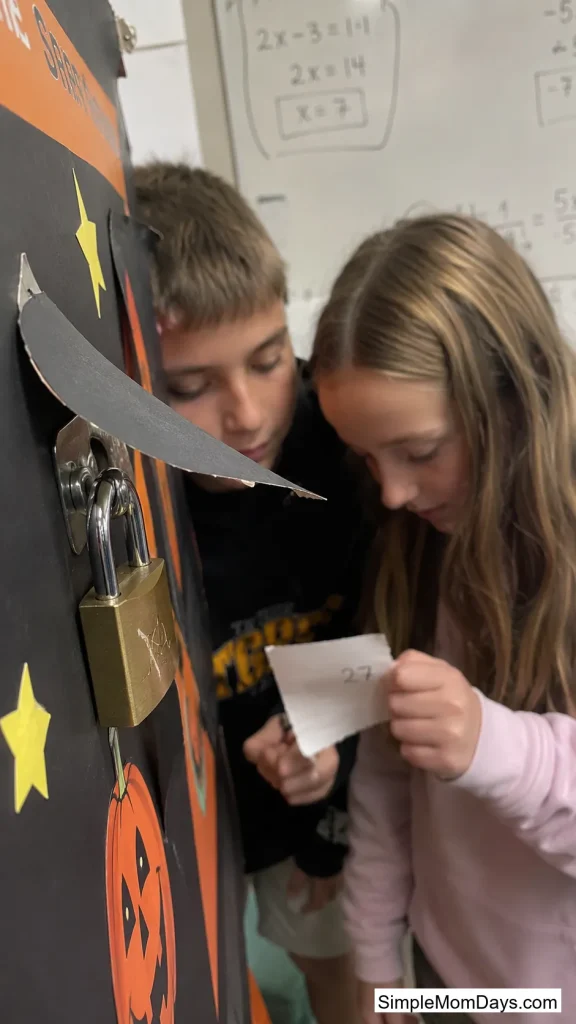
Hide three small padlocks — the kind used on diaries or luggage — behind flaps on the board, each requiring a code found by solving a riddle, math fact, or vocabulary clue posted nearby. Students who crack all three in order get to write their name on a “Cauldron Escapees” list pinned at the bottom.
Early finishers gravitate toward it without prompting, since it reads as a game instead of an assignment. It also gives a teacher an easy way to differentiate — swap in harder codes for older grades without redoing the whole board.
Combination bike locks work as a cheaper, reusable stand-in for padlocks if buying several isn’t in the budget. Reset the codes every couple of weeks to keep it from going stale.
Real Science Hiding in the Spooky Season
Halloween’s visual language — decay, potions, night skies, monsters — lines up with actual science content better than most teachers realize.
5. The Pumpkin Diary
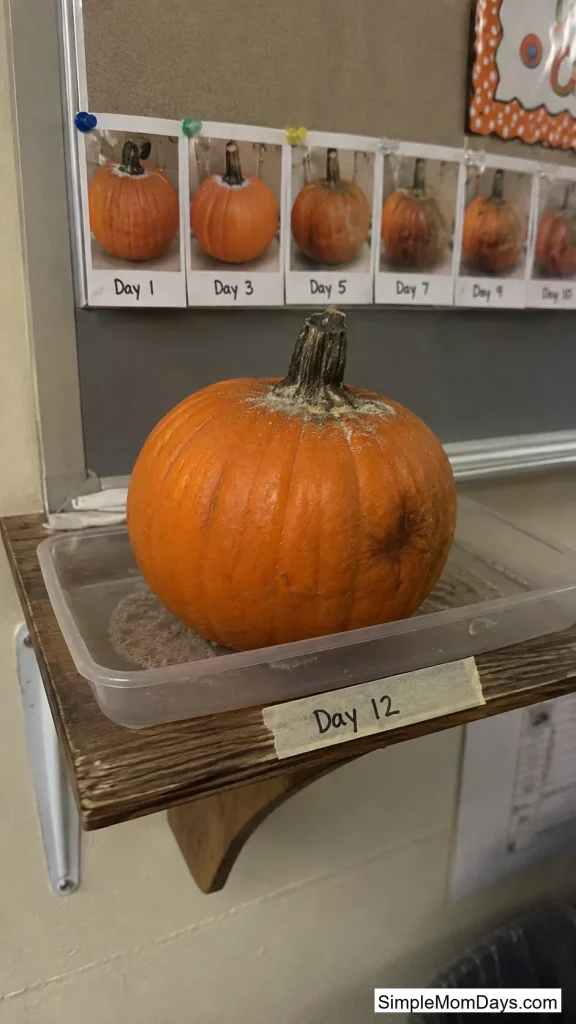
Set a real pumpkin on a small shelf attached to the board and photograph it every few days as it starts to soften, bruise, and eventually collapse in on itself. Pin each photo in a horizontal timeline with a one-line observation underneath — mold color, texture, smell if anyone’s brave enough to note it.
Decomposition is a standard science topic that usually gets taught from a diagram. Watching an actual pumpkin do it in real time, three feet from a kid’s desk, sticks in a way the diagram doesn’t.
Start the pumpkin around October 1st for a full month of visible change by Halloween. Keep it in a shallow tray — the later stages get genuinely messy.
6. Potion Lab
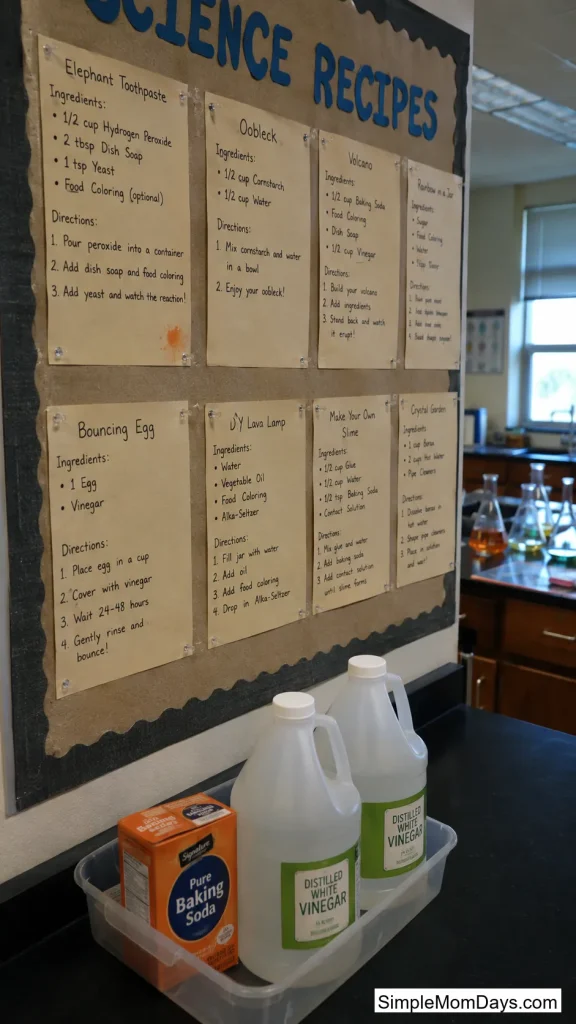
Style basic chemistry demonstrations — a baking soda and vinegar “potion,” oil and water separating, a color-changing pH reaction — as spell recipes on parchment-colored paper, complete with a supply list and a one-sentence explanation of what’s actually happening underneath the theme.
The Halloween framing gives cover to teach real vocabulary — solution, reaction, precipitate — to students who’d tune out a straight chemistry lesson but light up at the word “potion.”
Rotate one new “spell” each week rather than posting all of them at once, and keep the actual materials in a bin nearby so kids can try the safe ones during free time.
7. Monster Habitats
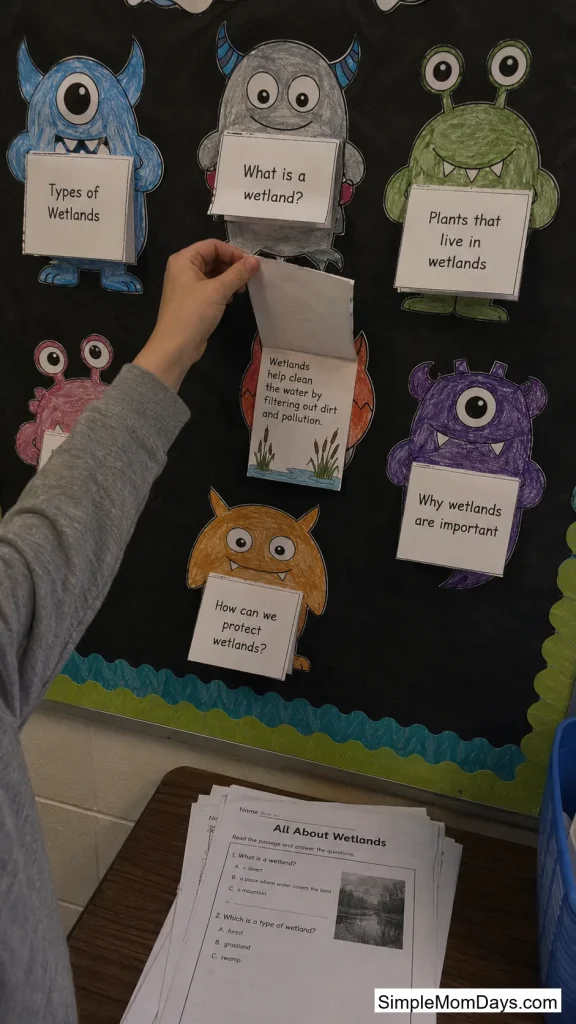
Pair classic Halloween creatures with the real-world biome that would actually suit them — a swamp monster next to wetland facts, a bat next to cave ecosystem details, a werewolf next to temperate forest information — and let students match creature to habitat before checking the answer under a flap.
It’s a habitat unit wearing a costume. Students remember which biome has which features because they’re solving a matching puzzle, not memorizing a list.
Works for second through fifth grade science standards almost without adjustment. Swap in real biome photos instead of illustrations if the goal is closer to a straight science lesson.
8. The Witch’s Star Map
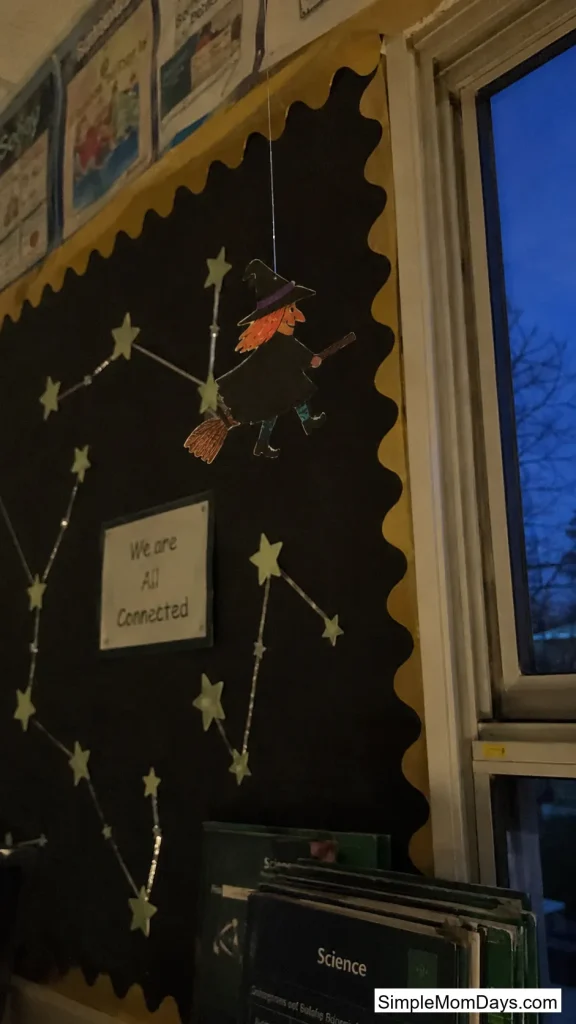
Chart the constellations actually visible in October — Cassiopeia, Pegasus, Andromeda — using glow star stickers connected with silver thread, with a small paper witch on a broomstick “flying” between them on a length of fishing line. Label each constellation with its real name and one fact.
Most fall bulletin boards borrow Halloween imagery without connecting to anything overhead that students can actually go outside and find. This one gives them a reason to look up that night.
Glow star stickers run about $6 for a set of over a hundred. Check a star chart app for the current month’s actual positions before placing them, so the map is accurate and not just decorative.
Halloween From Somewhere Else
Skipping the assumption that Halloween looks the same everywhere opens up a set of ideas most boards never touch.
9. Autumn Around the World
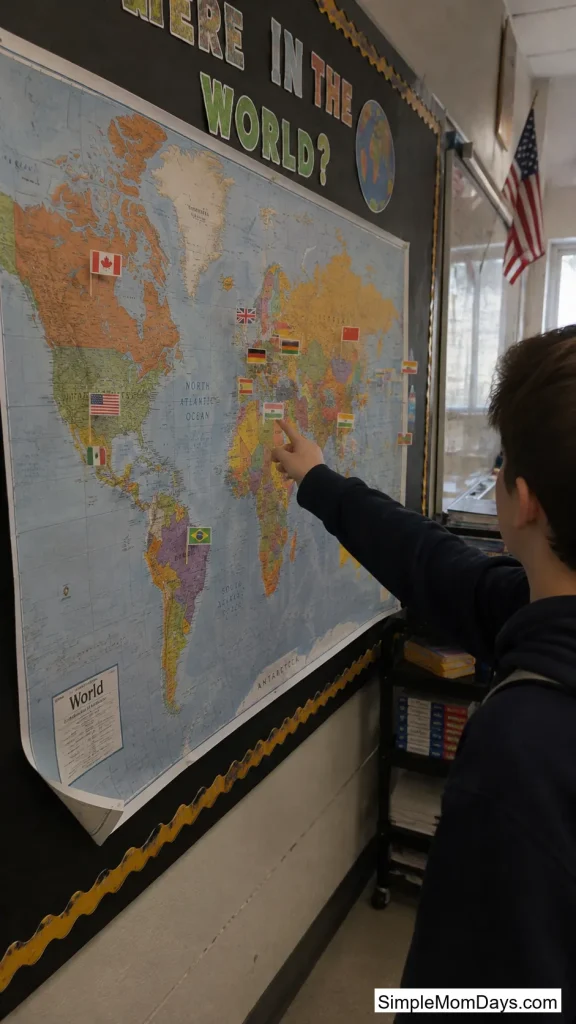
Map out how different cultures mark the same October–November window — Día de los Muertos in Mexico, Guy Fawkes Night in the UK, harvest festivals across parts of Asia — with a small flag or photo pinned to each country on a world map background.
It reframes Halloween as one version of a much bigger seasonal pattern instead of the only thing happening in October, which is a genuinely useful shift for a social studies or ESL classroom.
Ask students with family ties to other countries if they want to contribute a fact or a family tradition — it turns the board into something built with the class instead of just for them.
10. Cryptid Corner
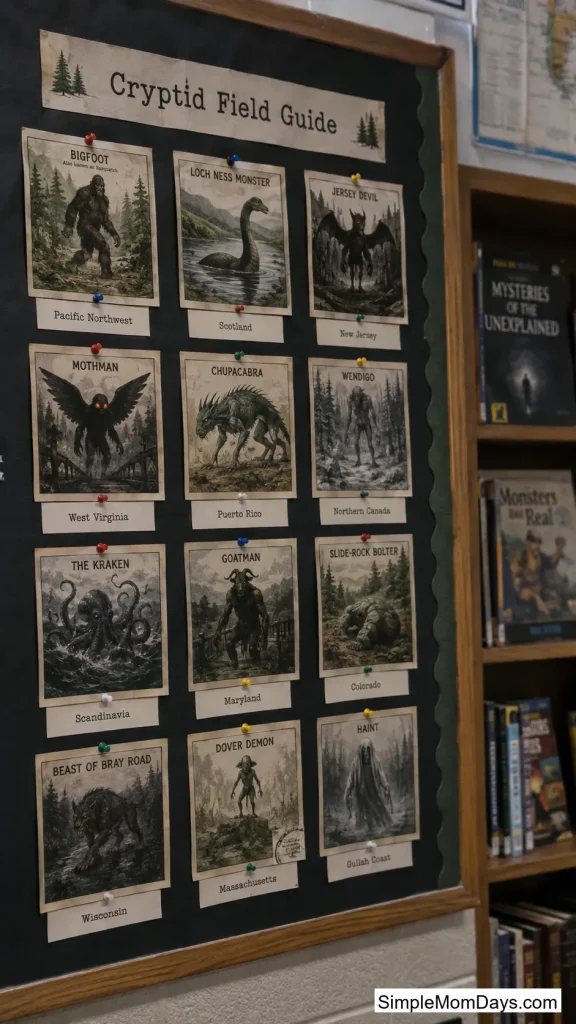
Skip the usual vampires and werewolves and feature real folklore creatures instead — Mothman, the Jersey Devil, the Loch Ness Monster, La Llorona — each with the region it’s associated with and a short summary of the legend, styled like a field guide entry.
Cryptids sit in the gap between myth and local history, which makes them a natural bridge into research skills — where the story started, why it persists, what explanations people have proposed over the years.
Middle schoolers especially respond to this one; it reads as slightly more grown-up than cartoon monsters without becoming genuinely frightening. Rotate in a new cryptid every few days if there’s room to grow.
11. Ghost Stories in Every Language
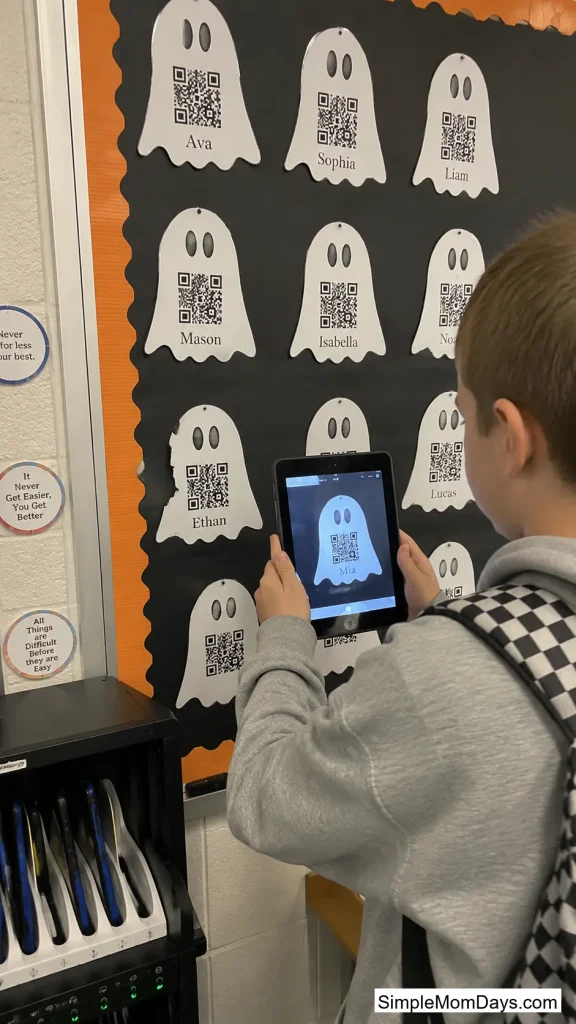
Have students record a 30-second spooky story on a classroom tablet — in English, a home language, or both — and print a QR code linking to the recording onto a small paper ghost labeled with their name. Pin the ghosts across the board so anyone walking by can scan and listen.
It’s a reading and speaking activity that doubles as decor, and it gives multilingual students a way to contribute in a language other than the one used for grading.
Free QR code generators handle the linking in under a minute once a recording is uploaded somewhere shareable, like a class Google Drive folder. Test one code before printing the whole batch.
Boards Built to Be Touched
Flat paper cutouts are the default for a reason — they’re fast — but a board with actual texture or depth gets noticed by kids who’ve stopped seeing the flat ones.
12. The Spider That Won’t Stay Flat
Build a spider out of black foam board or layered cardstock with legs bent forward at the joints so they extend off the surface and cast a real shadow, rather than a flat cutout pinned straight to the corkboard.
The shadow is what sells it — a flat spider reads as a shape, but one with legs jutting into open space reads as something that might actually move, which is exactly the reaction a Halloween board is going for.
Foam board scores and folds cleanly with the back of a butter knife along a ruler line. Angle a single desk lamp toward the board in the afternoon to exaggerate the shadow.

13. Guess by Touch
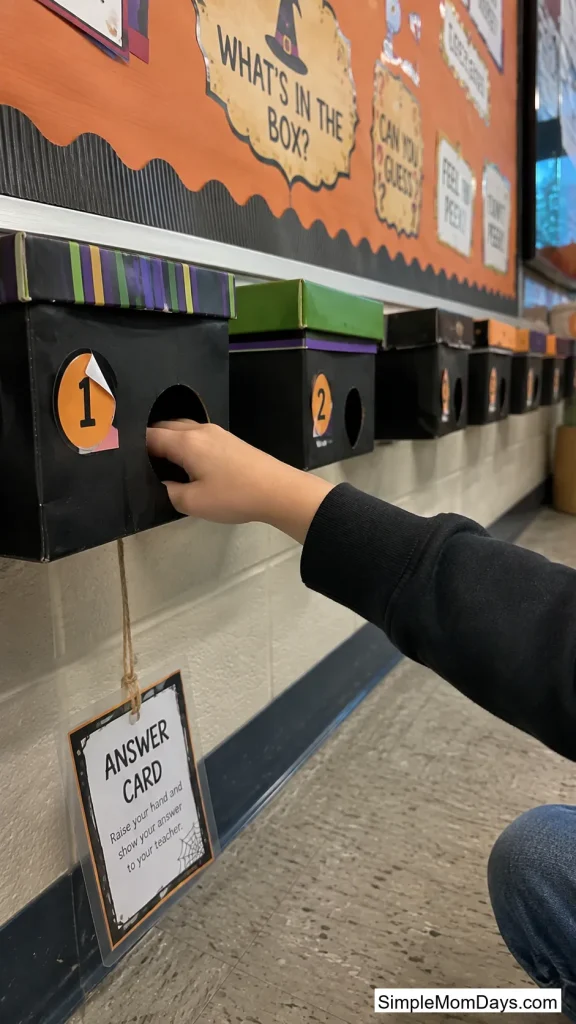
Cut small holes into a row of covered boxes mounted along the bottom of the board, each filled with a different texture — cold cooked spaghetti for “guts,” peeled grapes for “eyeballs,” dried corn husks for “witch hair” — and have students guess what’s inside by feel before checking the answer card.
It’s a sensory activity that happens to live on a bulletin board instead of a table, which means it stays available all month without taking up any desk space.
Swap the fillings every few days, since some — the spaghetti especially — don’t hold up past a day or two. Label the outside only with a number so the guess isn’t spoiled early.
14. Shadow Theater
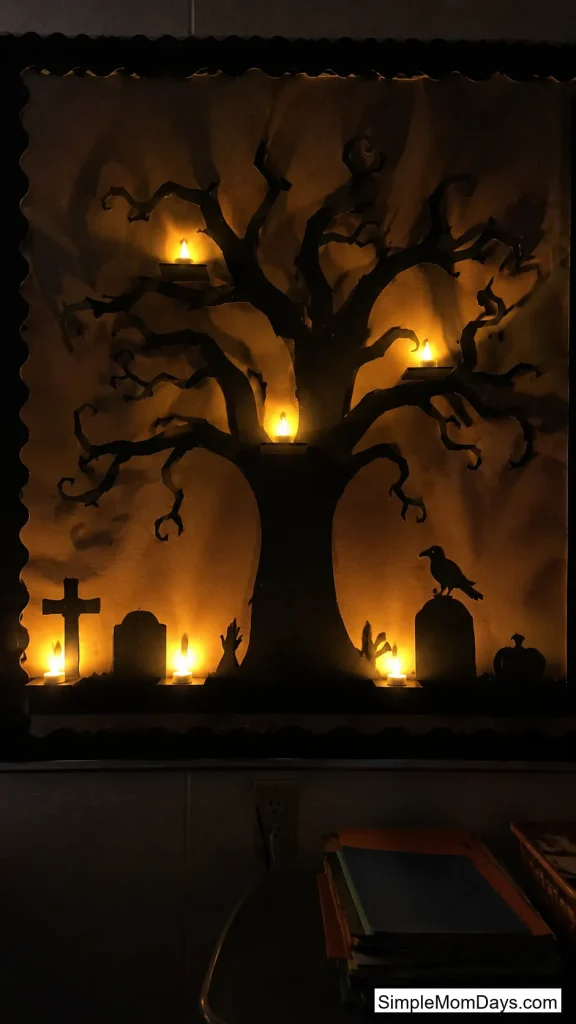
Cut a full scene — a haunted tree, a crescent moon, a cat on a fence — from black paper and mount it a few inches in front of a lit background, using battery tea lights, so the silhouette casts onto the board itself and creates a layered, stage-set look instead of a flat picture.
Depth is the whole trick. Most Halloween boards sit on one plane; this one has a literal foreground and background, which reads as more finished without requiring any extra drawing skill.
Battery tea lights avoid any cord or outlet issue near a corkboard. Test the shadow angle before mounting permanently — moving the light source even two inches changes how the silhouette falls.
Word-Nerd Boards
These lean on real vocabulary and persuasive writing instead of a caption pun, which makes them a better fit for a language arts wall.
15. Words That Go Bump in the Night
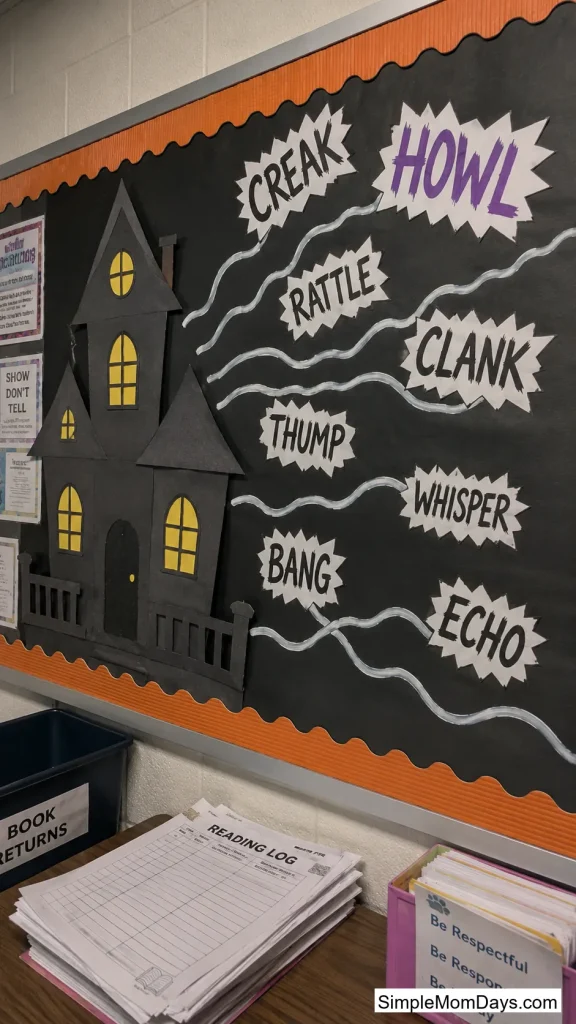
Build a board entirely around onomatopoeia — creak, howl, screech, rattle, moan — with each word written in jagged lettering along a wavy “sound line” radiating out from a central haunted house, so the board visually shows sound spreading outward instead of just listing words.
Onomatopoeia is a specific, testable figurative language term that Halloween vocabulary happens to be unusually rich in, which makes this an easy real-content swap for a generic “spooky words” word wall.
Ask students to submit one sound word from a book they’re currently reading — it keeps the list growing without extra prep from the teacher.
16. Dear Pumpkin King
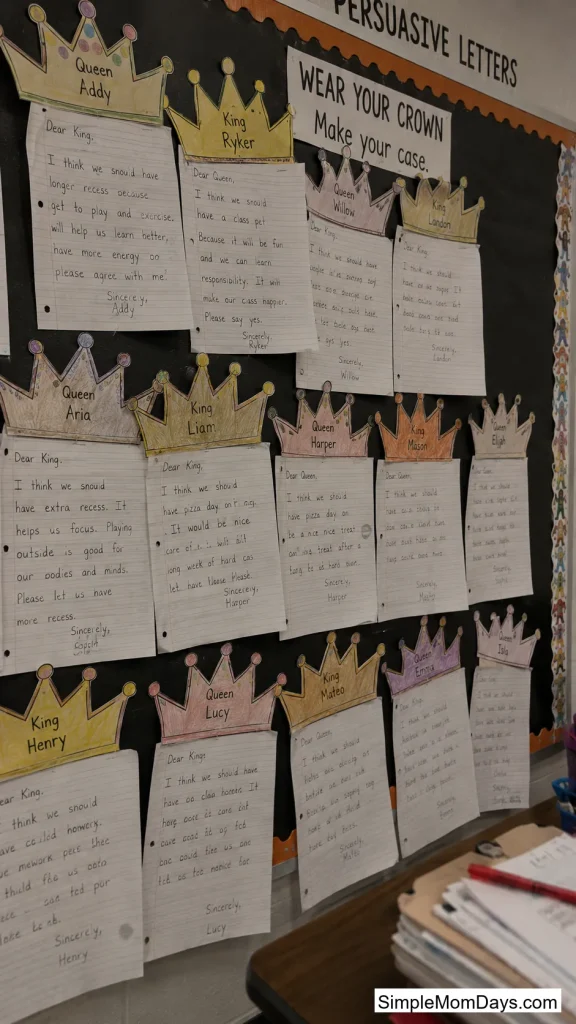
Set up a mock royal decree board where a fictional “Pumpkin King” is considering a new classroom rule, and students write short persuasive letters arguing for or against it — extra recess, a class pet, a change to the seating chart — addressed formally to His Gourdliness.
Persuasive writing usually gets taught through dry, abstract prompts. Writing to an invented authority figure about something students actually have opinions on gets more genuine argument out of them than a generic essay topic does.
Post the strongest letters on the board, each with a small paper crown, and have the “king” — the teacher, in character — write a one-line response to a few of them.
17. The Candy Exchange
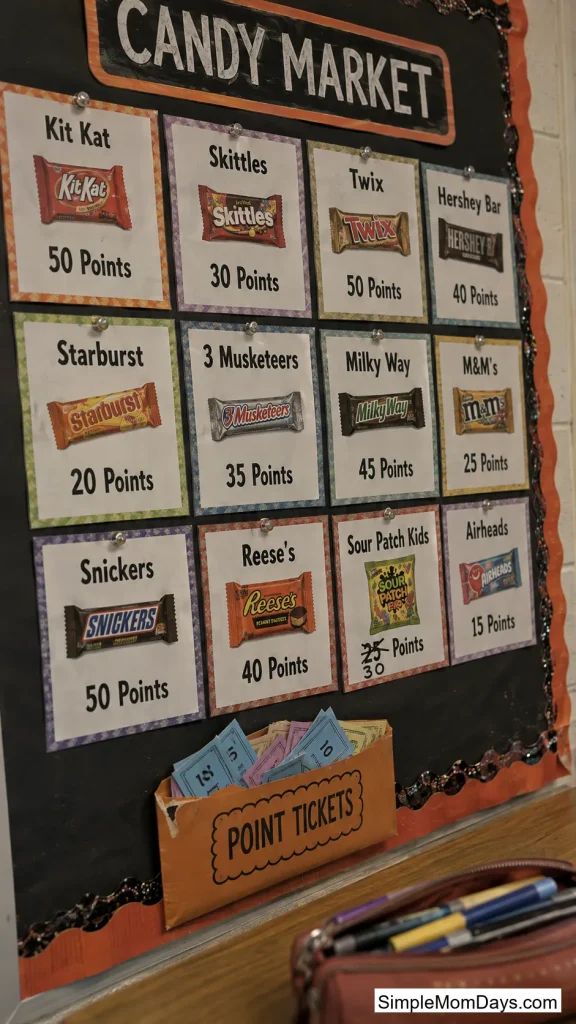
Post a running “market” where different candy types have shifting point values based on posted supply and demand — a candy that’s suddenly popular costs more points to trade for that week — and let students earn and spend points through classroom tasks, tracked on cards pinned to the board.
It teaches supply and demand through something a kid already has strong opinions about. Nobody needs convincing that a favorite candy is worth more than one nobody wants.
Use fake point tickets rather than actual candy to avoid any food-allergy complications, and adjust the “market prices” weekly based on which candy cards students request most.
Beyond the Classroom
A bulletin board doesn’t have to live between two rows of desks — the library, the front office, and the staff room all have blank cork just as often.
18. Caption the Costume
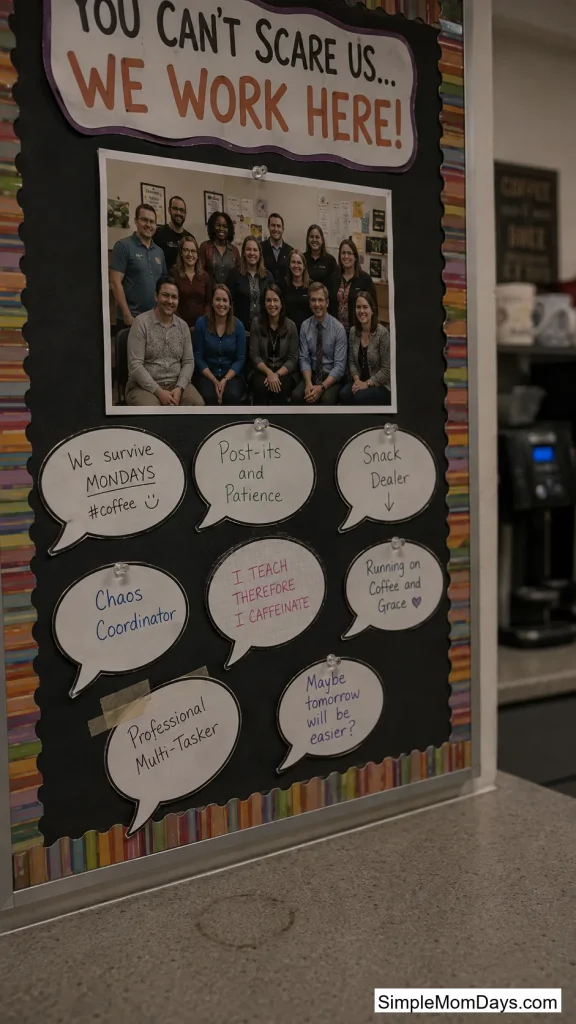
Post a candid staff photo each week — taken in the break room, not posed — and leave blank speech bubbles pinned below it for coworkers to fill in with a caption throughout the week, then swap in a new photo to start the next round.
It’s built for the faculty lounge specifically, where the audience is adults looking for a two-second laugh between classes rather than kids looking for decor.
Get informal consent from whoever’s in the photo before it goes up, and set an easy end date each week — Friday afternoon — so the captions don’t sit stale into the following week.
19. The Banned Books Graveyard
Design the library board as a small graveyard where each tombstone displays the cover and a one-line summary of a book that’s been challenged somewhere in the country, with a short note on why — paired with a sign-out sheet for students who want to check one out.
It ties Halloween’s graveyard imagery to an actual, current library topic instead of using tombstones purely as decoration, and it tends to make students more curious about the books, not less.
Stick to titles already in the school’s own catalog so the checkout sheet leads somewhere real. A short note explaining what “challenged” means keeps it factual instead of editorial.

20. Your Teacher, Monster-Fied
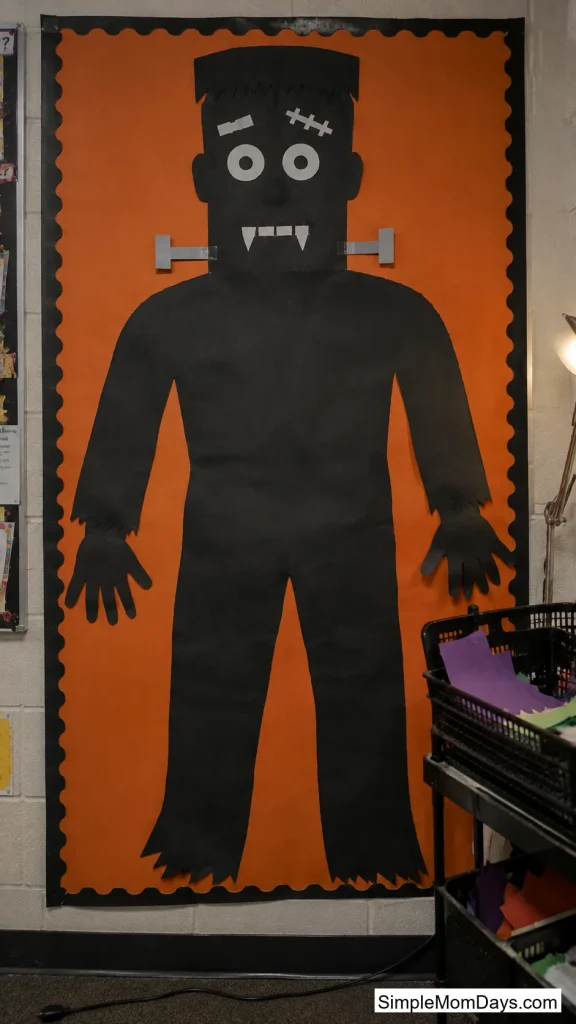
Trace an actual silhouette of the teacher — stand against the board under a bright light while a student traces the shadow onto black paper — then add monster features like bolts, fangs, or fur to the traced outline instead of using a generic pre-cut Frankenstein shape.
Using the real teacher’s silhouette instead of a stock shape is what makes it land — students recognize the actual posture and profile, which is a different kind of funny than a clip-art monster.
A single desk lamp a few feet away and a straight-on angle give the cleanest, most recognizable outline. Let students vote on which monster features to add.
Gentle Halloween for Little Learners
For preschool and early elementary rooms — or any school that keeps Halloween low-key — these skip anything actually scary while still bringing in the season.
21. What’s Brewing in the Cauldron
Post simple, healthy Halloween-week snack ideas — apple “monster mouths,” clementine “pumpkins,” yogurt “ghosts” — as recipe cards shaped like potion bottles, each with a picture and three or four ingredients listed in large print.
It gives families a low-effort answer to “what do I send for the class party” while sneaking in early reading practice as kids sound out ingredient names on the cards.
Keep every recipe nut-free and simple enough for a five-year-old to help assemble, and send a printable copy of each card home the week before the party.

22. The Cauldron Forecast
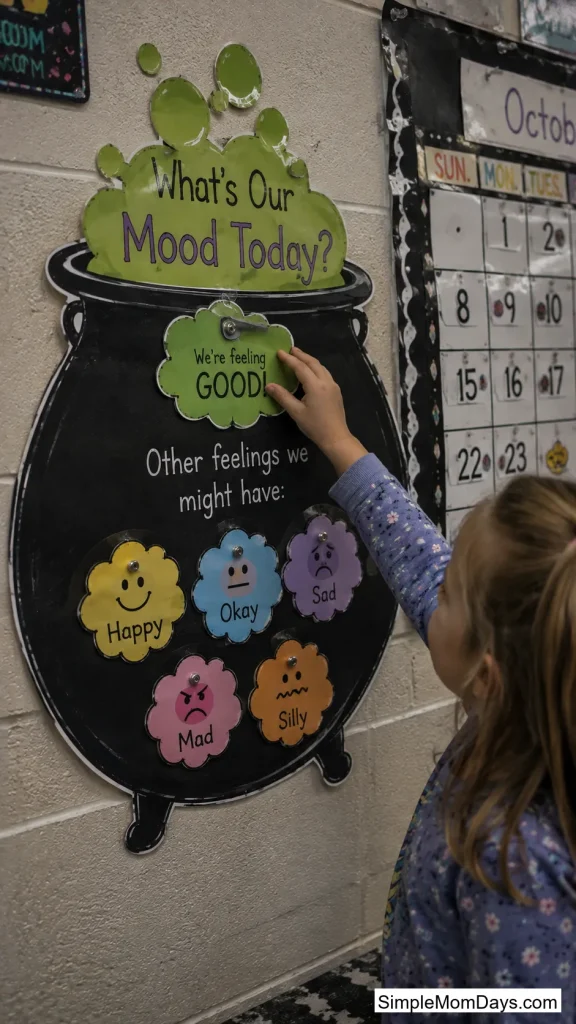
Track the real daily weather on a small chart shaped like a bubbling cauldron, with a movable paper cloud, sun, or raindrop that a student updates each morning, plus a “spooky scale” sticker — calm, breezy, howling wind — layered on top of the actual temperature and conditions.
It keeps a genuinely useful daily classroom routine, the weather check, going through October without needing to swap the whole board out for something separately Halloween-themed.
Assign a different “weather witch” each day to move the pieces — it’s a five-second job that gives every kid a turn by the end of the month.
23. Feelings Potion
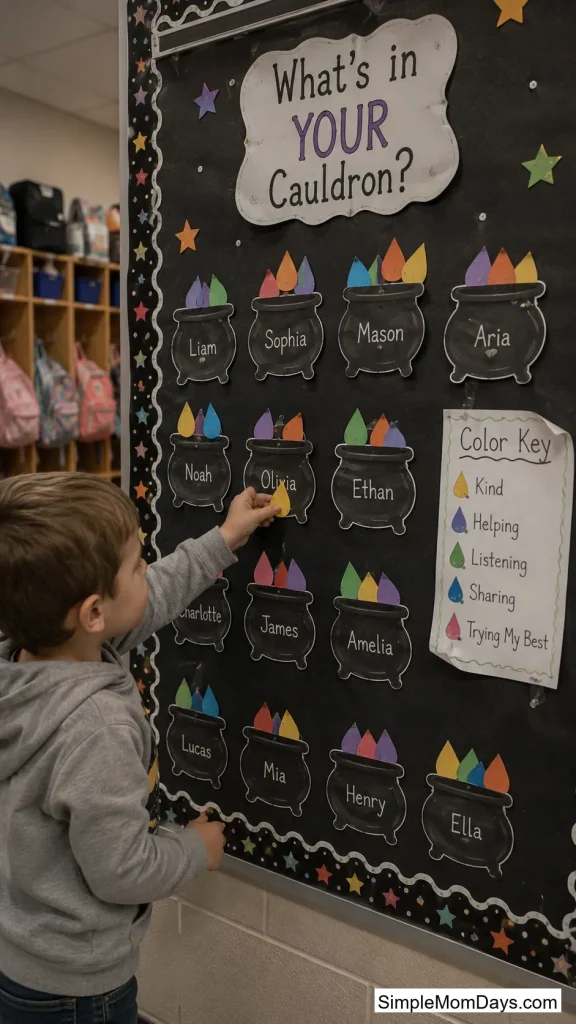
Set up a daily check-in where students add a colored paper “ingredient” to their own small cauldron cutout based on how they’re feeling — a red drop for frustrated, a blue drop for calm, a yellow drop for excited — building a simple visual mood log across the week instead of a single static face.
It turns a one-time “how are you feeling” prompt into an ongoing pattern a teacher can actually glance at, and gives younger kids a concrete action for something that’s usually just a verbal check-in.
Keep the color-to-feeling key posted directly on the board so kids don’t have to remember it, and empty each cauldron at the start of a new week.
Final Thoughts
Twenty-three is a lot to hold at once. Pick two or three that actually fit the grade level and subject in front of you, build those well, and let the rest sit as backup for next October.