


A sleeve of plastic cups costs about two dollars and turns into more entertainment than most party favors combined. Add a timer and whatever’s already in the kitchen drawer — ping pong balls, balloons, straws, a few marbles — and you’ve got a full lineup of minute to win it games ready to go.
These work for birthday parties, family game nights, or a rainy afternoon with nothing else planned. Play them one at a time, or set up a few stations and let everyone rotate through for a mini “Minute to Win It Olympics.”
Here are 21 cup games sorted by what they actually test — steady hands, good aim, teamwork, or a sharp memory — so you can pick a mix that fits your group instead of running the same five stacking games every time.
Classic Cup Stacking Challenges
These are the foundation of any minute to win it lineup. All you need is a stack of identical cups, though a second color opens up a few extra variations.
1. Cup Pyramid Race
Give each player ten cups. On “go,” they build a pyramid — four cups on the bottom row, then three, then two, then one on top — and then tear it back down into a single stack before the minute ends. Both the build and the collapse have to happen cleanly; if the pyramid falls mid-build, the player starts over from wherever it landed.
It looks easy the first time someone explains it and turns into a genuine hand-eye coordination test the moment the clock starts. Ten cups is the standard count, but bump it to 15 or 21 for older kids and adults who blow through the easier version in twenty seconds flat.

2. Tallest Tower Challenge
Players get a pile of 20 to 25 cups and one minute to build the tallest freestanding tower they can manage. Any shape counts — straight stack, staggered, wide base narrowing up — as long as it’s still standing when time runs out.
If the tower collapses before the minute is up, the player has to rebuild instead of stopping, which is what makes this more nerve-wracking than a straightforward stacking game. Measure the winning tower with a tape measure for bragging rights, or just eyeball whoever’s clearly ahead.
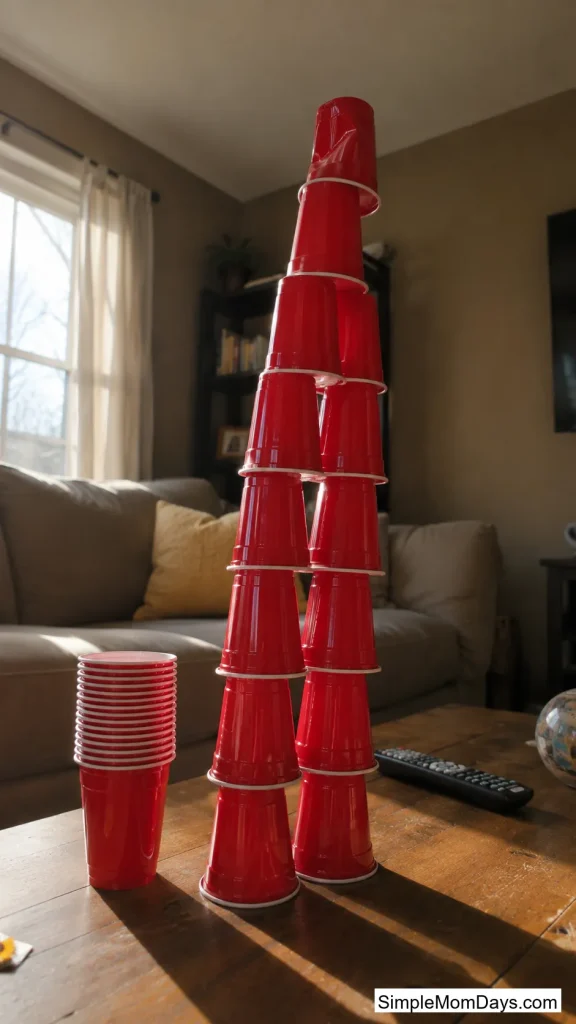
3. Movin’ On Up
Stack 20 same-colored cups together, then set one cup of a different color on top. When the timer starts, the player moves the bottom cup to the top, one at a time, working the odd-colored cup back down through the stack and then back up again before time runs out.
It’s a repetitive motion game, which makes it a good palate cleanser between the more chaotic challenges on this list. Twenty cups is a solid starting point; drop to 12 for younger kids who’ll lose patience with the longer version.
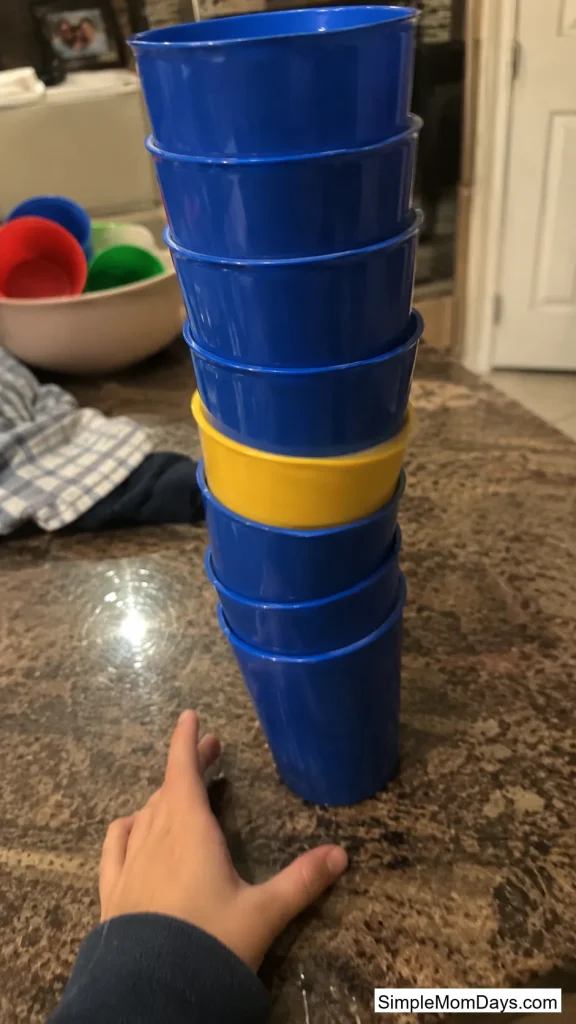
4. Cup Drop Stack
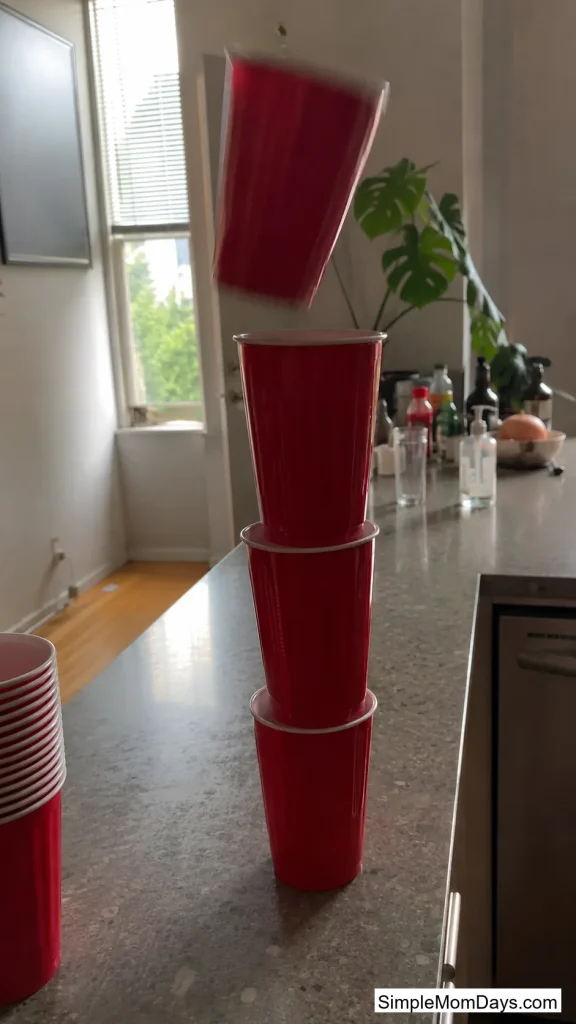
Players stand at a counter or tall table with a stack of cups and drop them one at a time, trying to land each cup rim-to-rim on top of the last so they stack themselves on the way down. No hand-placing allowed — the cups have to land where they land.
This one sounds almost too simple until the third cup bounces sideways off the second and the whole thing has to start over. Count how many successful stacked cups each player manages in one minute rather than requiring a perfect tower, since very few people clear more than five or six in a row.
Ping-Pong & Toss Cup Games
Grab a bag of ping pong balls for this group — they’re inexpensive, bounce well, and don’t sting the way a harder ball would when someone gets hit.
5. Cup Pong Toss
Arrange six to ten cups in a triangle, like bowling pins, and give the player a small pile of ping pong balls. The goal is landing as many balls in the cups as possible in sixty seconds, either by tossing directly or bouncing off the table first.
Direct toss is easier for younger kids; bounce-only makes it a real challenge for teens and adults. Count total balls landed rather than requiring every cup to be filled, since a full sweep in one minute is rare even for a steady hand.

6. Tic-Tac-Toe Cups
Fill nine cups about three-quarters full of water and arrange them in a 3×3 grid. Two players take turns bouncing ping pong balls toward the grid, trying to land three balls in a row — across, down, or diagonal — before their opponent does or before the minute runs out.
Water in the cups keeps a landed ball from bouncing right back out, which matters more than it sounds like it would. For a longer round, skip the tic-tac-toe win condition and just play for a “blackout,” where the first team to land a ball in all nine cups wins outright.

7. Ball Drop Balance
Set a single plastic cup on the floor with a sturdy chair positioned directly behind it. The player stands on the chair with three ping pong balls and tries to drop all three into the cup without a single miss or bounce-out.
Three balls sounds like nothing until gravity and a slightly unsteady chair get involved. Give players unlimited attempts within the minute and count how many clean drops they land, or raise the stakes by requiring all three in a row with no misses.

8. Trick Shot Bounce
Set out four or five cups at staggered distances on a table — some close, some at the far edge — and have the player bounce ping pong balls off the table into whichever cup they’re aiming for. Closer cups are worth fewer points, distant ones worth more.
This rewards actual aim over lucky bounces, which makes it a good late-round game once players have warmed up on the easier toss challenges. Tally points instead of makes for a scoring system that rewards going for the harder shots.

Balloon & Straw Cup Games
These trade ping pong balls for balloons and straws, which shifts the challenge from aim to breath control and lung capacity.
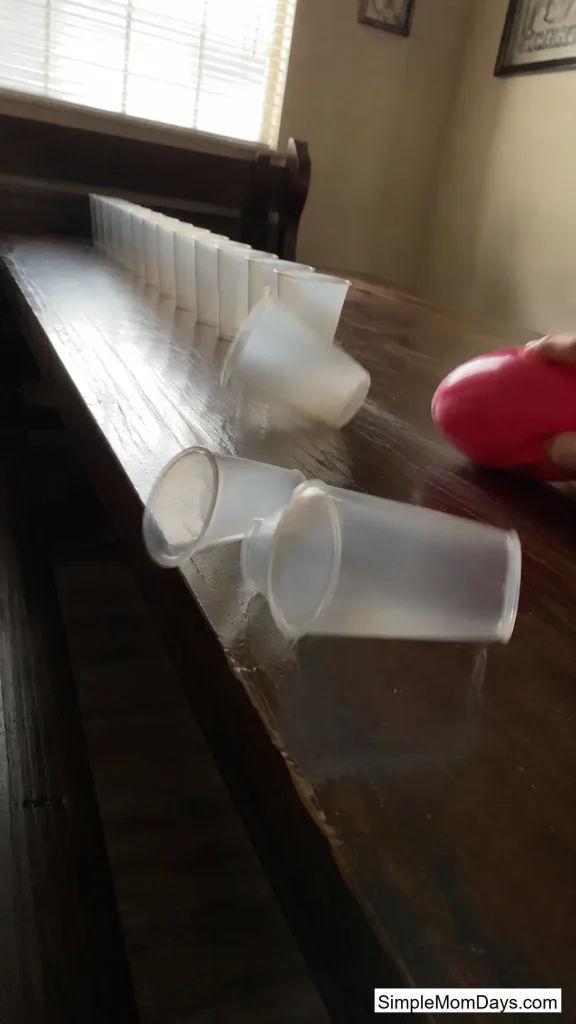
9. Blow the Row
Line up 10 to 15 lightweight cups along the edge of a table. The player blows up a balloon, then releases the air toward the cups to knock them off — no touching the cups directly, and no blowing on them with just their mouth.
Refilling the balloon takes precious seconds off the clock, so players learn fast that a few big blasts beat a lot of small ones. Count how many cups end up off the table when the minute ends.
10. Straw Suction Sort
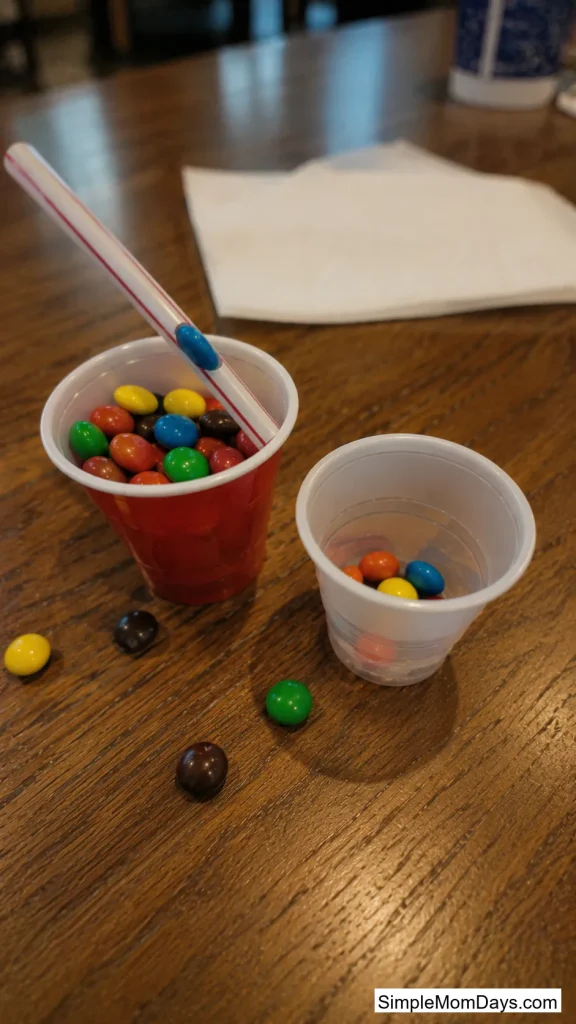
Fill a small cup with mixed candy — M&Ms work well since they’re uniform in size — and set an empty cup beside it. Using only suction through a straw, the player moves as many pieces as possible from the full cup to the empty one in one minute.
Dropped candy doesn’t count, so a slow, steady approach usually beats rushing. This one’s genuinely tough for younger kids with smaller lung capacity, so consider a shorter 30-second version for players under six.
11. Bubble Relay
Fill three or four cups partway with water and line them up in a row on a table. The player drops a ping pong ball into the first cup and has to blow it across the line of cups to the last one, using breath only — no touching.
Watching the ball skip from cup to cup on a well-aimed breath is oddly satisfying, and getting the angle wrong sends it flying off the table entirely. If the ball falls out mid-attempt, the player resets to the first cup rather than losing the whole minute.

Team Relay Cup Games
These need at least two players per team and work best with a bigger group split into even lines.
12. Cup Stack Relay Race
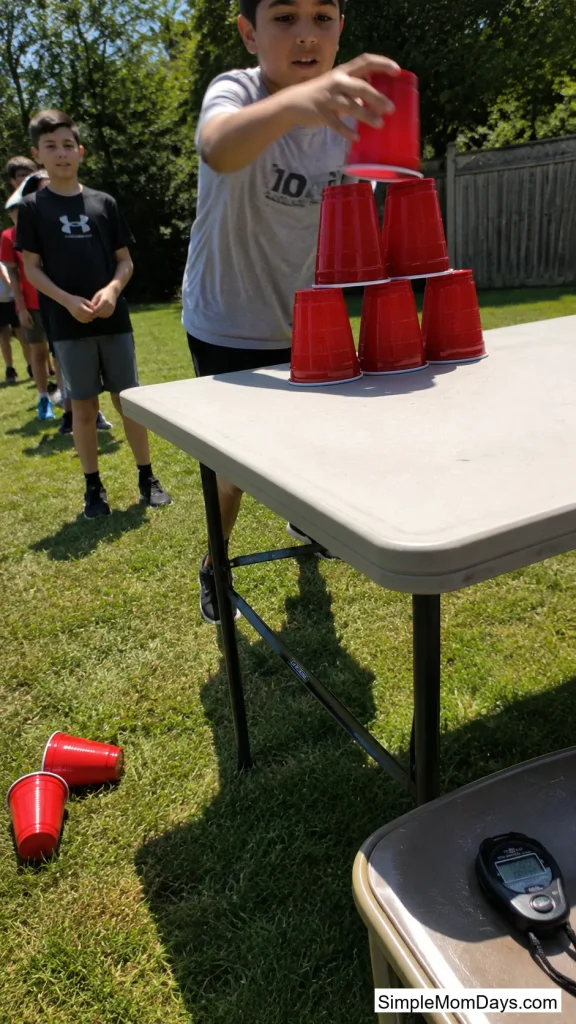
Split into teams of three or four. Each team member takes a turn running to a table, stacking 12 cups into a pyramid, unstacking them back into one pile, and running back to tag the next teammate. First team through every player wins.
The relay format keeps everyone involved instead of one person carrying the whole round, which makes it a strong choice for bigger parties where not everyone wants a solo turn in the spotlight. Add a one-foot hop on the way to the table for an extra layer of difficulty with older kids.
13. Bucket Brigade Cup Pass
Form two lines of players sitting or standing single file, with a full bucket of water at the front of each line and an empty bucket at the back. Each person fills a small cup from the bucket in front of them and passes it overhead to the next person in line, all the way down to the final bucket.
Whichever team has more water in the back bucket when the minute ends wins — and yes, a fair amount ends up on the floor and on shoulders along the way. Run this one outside or over a tarp, since it gets wet fast.

14. Toe-to-Toe Cup Catch
Pair players up, each holding one cup, standing toe to toe with a single ball between them. One player tosses the ball into the other’s cup; if it’s caught cleanly, both partners take a step backward before the next toss.
A missed catch means the pair steps back together to try again from the closer distance. Whichever pair has the most space between them when the minute ends wins, which makes for a surprisingly tense final ten seconds as pairs creep further and further apart.

Skill & Trick Cup Games
This group leans on steady hands and repetition more than raw speed — good for a quieter stretch of the party once everyone’s had a turn at the louder games.
15. Cup Flip Frenzy
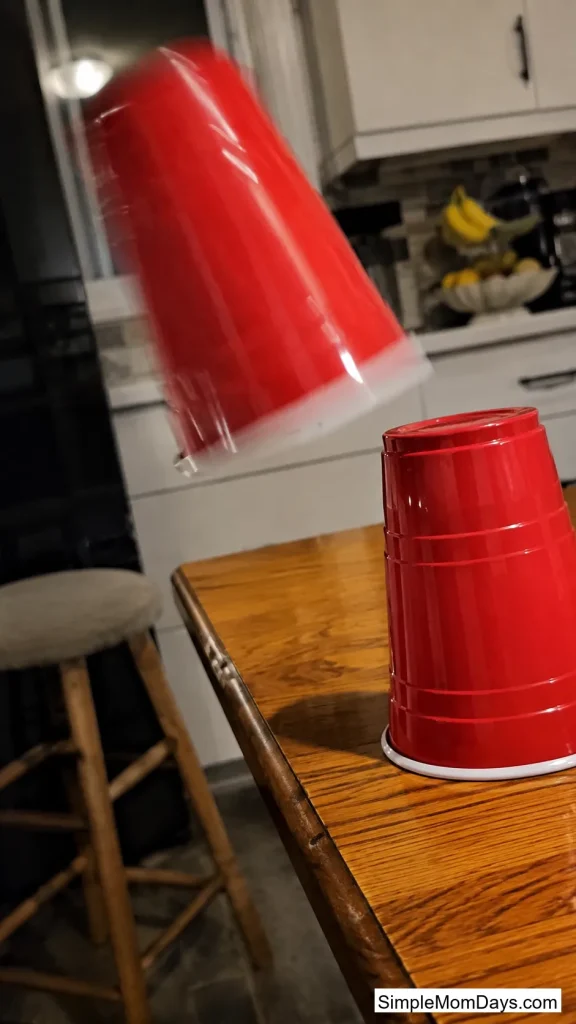
Set a cup right-side up on the edge of a table. The player flicks the overhanging rim so the cup flips through the air and lands upside down, repeating as many successful flips as possible in one minute.
It looks like a party trick and takes real practice to land consistently. For a team version, give each side five stacked cups and have them flip through the whole stack, tallying total successful flips per team instead of per person.
16. Bottle Landing Flip
Set a bottle upright a short distance from the player. Using one hand, they flick a cup so it flips through the air and lands rim-down on top of the bottle, repeating until they land it or the minute runs out.
This is a step up in difficulty from a standard cup flip since the target is small and easy to knock over entirely. Count total successful landings for players who get the hang of it quickly, since some will land three or four in a minute once they find the right flick.

17. Marble Spin Cup
Set a marble on the table or floor and place a cup mouth-down over it. The player spins the cup so the marble spins along with it, then lifts the cup slightly and moves it to a new spot without ever letting the marble stop rolling or escape.
Adults can be sent walking between two locations across the room; younger kids can play this one seated in place. It’s a quieter, more meditative game compared to the toss-and-catch chaos of the rest of the list, which makes it a nice change of pace mid-party.

18. Tilty Cup Catch
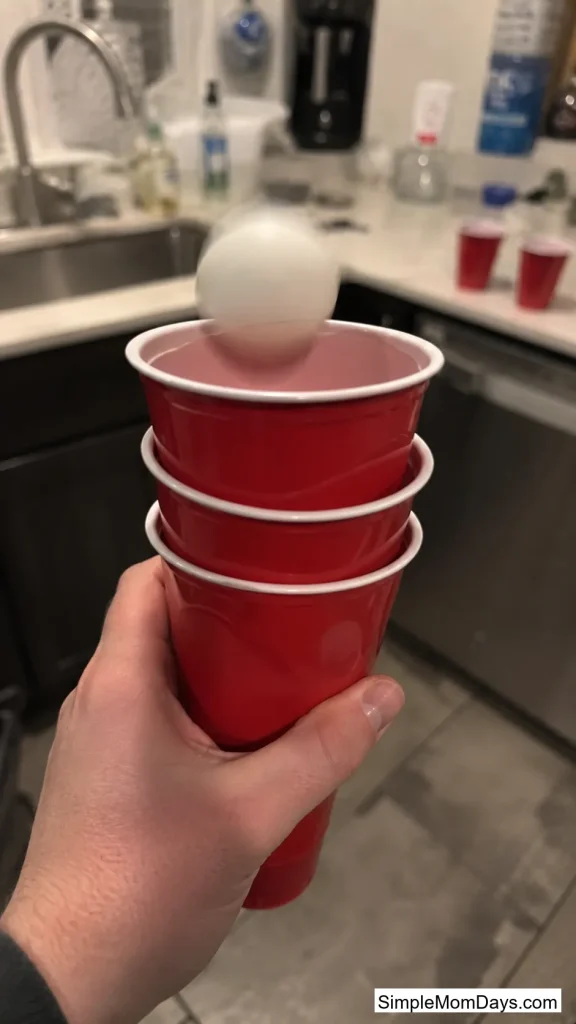
Stack five cups in one hand. The player bounces a ping pong ball into the top cup, then quickly slides the bottom cup out and places it on top of the ball before it can bounce back out, repeating the process to build height while keeping every ball trapped inside.
Each successful catch makes the next one wobblier, since the stack keeps growing while balanced on nothing but caught balls. This is genuinely one of the harder games on the list — most players are thrilled to land two or three catches before the minute’s up.
Memory & Sorting Cup Games
A change of pace from physical challenges, these test recall and quick sorting instead of aim or balance.
19. Cup Match Memory
Write numbers one through eight twice on small slips of paper, tape one under each of 16 upside-down cups, and arrange them in a 4×4 grid. Players flip two cups at a time looking for a match, keeping any matched pair and continuing until the minute runs out.
Swap numbers for holiday images or a birthday kid’s name to tie it into a party theme without changing the mechanic. Count total matched pairs for players competing head to head on separate grids.

20. Color Sort Scramble
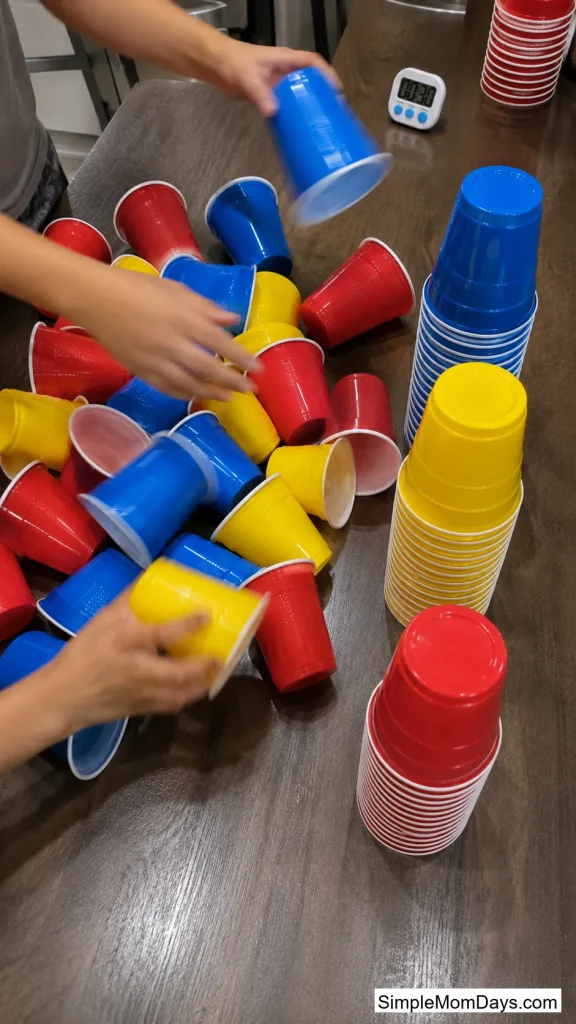
Mix two or three colors of cups together in one big pile. The player has to sort and stack them by color into separate towers before the minute runs out, working as fast as they can without letting any stack topple.
This tests speed and a bit of hand control at the same time, since rushing tends to knock over whichever stack is already built. Twenty to thirty total cups across the colors keeps this challenging without dragging past the full minute.
21. Mitten Catch Toss
Give the player two cups to wear like mittens, one on each fist, and a pile of cotton balls or pom-poms in front of them. Using only the cups on their hands — no fingers — they scoop and toss cotton balls into a third cup set a short distance away.
This is one of the easiest games on the list to adapt for younger kids, since there’s no real risk of injury and the cup-mittens make even a clumsy toss feel like an accomplishment. Count total cotton balls landed in the target cup when time’s up.
Twenty-one games is more than enough for a full afternoon, so don’t feel obligated to run through the whole list in one sitting. Pull four or five that fit your group’s ages and energy level, keep a phone timer handy, and let the games decide the order — the loudest ones tend to work best right after everyone’s finished eating.
